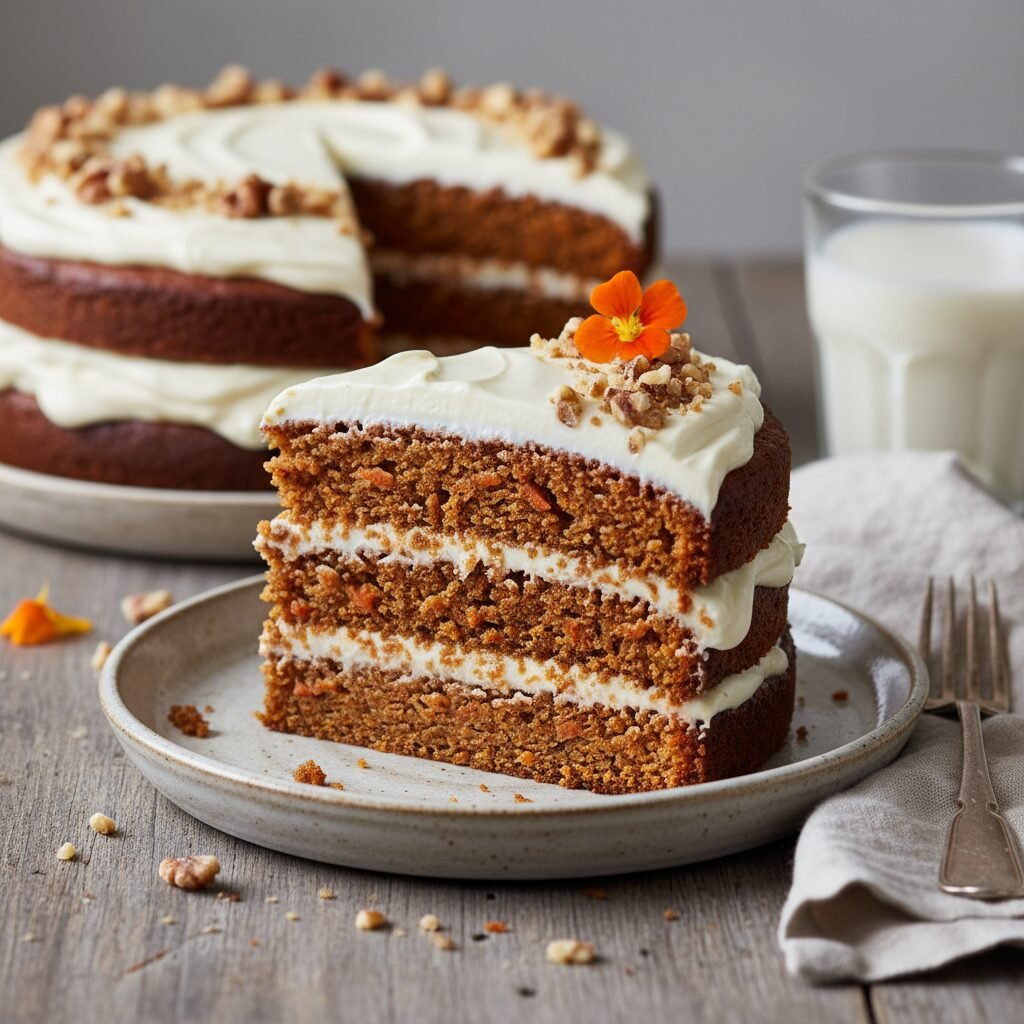
The Ultimate Moist Vegan Carrot Cake with Tangy Cream Cheese Frosting
Moist Vegan Carrot Cake Recipe
Forget everything you know about vegan baking—this incredibly moist vegan carrot cake is tender, spiced to perfection, and topped with a velvety dairy-free cream cheese frosting. It is a crowd-pleasing dessert that no one will ever guess is completely plant-based.
25 minutes
35 minutes
1 hour
12 servings
Dessert
Baking
American
Vegan
There is something undeniably comforting about a classic carrot cake. It is the sort of dessert that bridges the gap between a morning pastry and a decadent after-dinner treat. For years, the stigma surrounding vegan baking has been that removing eggs and dairy results in a dry, dense, or crumbly disaster. I am here to shatter that myth completely. This Moist Vegan Carrot Cake recipe is the culmination of years of testing, tweaking, and tasting to find the perfect balance of spice, sweetness, and structural integrity without using a single animal product.
The magic lies in the combination of warming spices—cinnamon, nutmeg, and ginger—marrying with the natural sweetness of freshly grated carrots and the subtle nuttiness of toasted walnuts. Unlike butter-based cakes that can firm up in the fridge, this oil-based sponge stays incredibly soft and tender for days. Whether you are baking for a birthday, a holiday gathering, or just a cozy Sunday afternoon, this cake delivers a bakery-style experience right in your own kitchen. We finish it off with a tangy, luscious vegan cream cheese frosting that provides the perfect creamy counterpoint to the textured, spiced crumb. Get ready to add a new family favorite to your recipe box.
History & Origins
The history of carrot cake is as rich and layered as the dessert itself, tracing its roots back much further than the cream cheese-frosted squares we know today. Historians generally agree that carrot cake evolved from ‘carrot puddings’ eaten by Europeans in the Middle Ages. During this era, sugar and sweeteners were rare and prohibitively expensive for the common family, so carrots—which contain more natural sugar than almost any other vegetable besides sugar beets—were used as a primary sweetening agent in desserts.
The modern evolution of the cake began to take shape during World War II. In the United Kingdom, rationing of sugar and luxury ingredients led the Ministry of Food to promote recipes using carrots as a healthy, homegrown sweetener. This cemented the carrot’s place in baking culture. However, it wasn’t until the 1960s and 1970s in the United States that carrot cake truly exploded in popularity. Driven by a growing interest in ‘health foods,’ the inclusion of a vegetable in a cake made it seem like a guilt-free indulgence. It became a staple in American cafes and restaurants, eventually becoming inseparable from the rich cream cheese frosting that was popularized around the same time. Today, we honor this centuries-old tradition by adapting it for the modern plant-based palate, proving that this historic dessert is timeless.
Why This Recipe Works
This recipe succeeds where many other vegan cakes fail because it relies on the science of baking to replace eggs and dairy effectively, rather than just omitting them. First, we use a combination of oil and applesauce. Oil is liquid at room temperature (unlike butter), which ensures the cake remains moist and soft even when chilled. The applesauce acts as a binder, mimicking the structure usually provided by eggs, while adding natural pectin and moisture without weighing the batter down.
Furthermore, the chemical leavening is carefully calculated. We use a ‘vegan buttermilk’ method by combining almond milk with apple cider vinegar. The acid in the vinegar curdles the milk slightly and, more importantly, reacts vigorously with the baking soda. This reaction creates carbon dioxide bubbles, giving the cake a significant lift and a fluffy, airy crumb that rivals any conventional cake. Finally, using brown sugar introduces molasses, which is hygroscopic—meaning it attracts and holds water—guaranteeing that ‘melt-in-your-mouth’ texture that defines a truly great carrot cake.
Why You’ll Love This Recipe
- ✓100% Vegan and Dairy-Free
- ✓Stays moist for days thanks to oil and brown sugar
- ✓Richly spiced with cinnamon, nutmeg, and ginger
- ✓Includes a fail-proof vegan cream cheese frosting
- ✓Can be made as a layer cake or cupcakes
- ✓Requires no obscure ingredients—just pantry staples
Equipment You’ll Need
- ✓Two 8-inch round cake pans
- ✓Large mixing bowl
- ✓Medium mixing bowl
- ✓Box grater or food processor
- ✓Whisk
- ✓Rubber spatula
- ✓Electric hand mixer or stand mixer
- ✓Wire cooling rack
- ✓Parchment paper
Ingredients
- ✓2 1/2 cups all-purpose flour
- ✓2 cups grated carrots (approx. 4-5 medium carrots)
- ✓1 1/2 cups brown sugar, packed
- ✓1/2 cup granulated sugar
- ✓3/4 cup neutral oil (canola, vegetable, or melted coconut oil)
- ✓1/2 cup unsweetened applesauce
- ✓1 cup unsweetened almond milk (or soy milk)
- ✓1 tablespoon apple cider vinegar
- ✓2 teaspoons vanilla extract
- ✓2 teaspoons baking powder
- ✓1 teaspoon baking soda
- ✓1/2 teaspoon salt
- ✓2 teaspoons ground cinnamon
- ✓1 teaspoon ground ginger
- ✓1/4 teaspoon ground nutmeg
- ✓1 cup chopped walnuts or pecans (optional)
- ✓For the Frosting: 1/2 cup vegan butter sticks, slightly softened
- ✓For the Frosting: 8 oz vegan cream cheese, slightly softened
- ✓For the Frosting: 3-4 cups powdered sugar, sifted
- ✓For the Frosting: 1 teaspoon vanilla extract
Instructions
- Preheat your oven to 350°F (175°C). Grease two 8-inch round cake pans with oil and line the bottoms with parchment paper to prevent sticking.
- In a small bowl or jar, combine the almond milk and apple cider vinegar. Stir and let it sit for about 5-10 minutes to curdle into vegan buttermilk.
- Peel and grate the carrots using the medium holes of a box grater. Do not use pre-shredded store-bought carrots as they are too dry. Set aside.
- In a large mixing bowl, whisk together the flour, baking powder, baking soda, salt, cinnamon, ginger, and nutmeg until well combined and no lumps remain.
- In a separate medium bowl, whisk together the oil, brown sugar, granulated sugar, applesauce, vanilla extract, and the prepared vegan buttermilk mixture. Whisk until the sugar is mostly dissolved.
- Pour the wet ingredients into the dry ingredients. Use a rubber spatula to mix gently. Stop mixing as soon as the flour streaks disappear to avoid overworking the gluten.
- Fold in the grated carrots and chopped walnuts (if using) until evenly distributed throughout the batter.
- Divide the batter evenly between the two prepared cake pans. Tap the pans gently on the counter to release any large air bubbles.
- Bake for 30-35 minutes, or until a toothpick inserted into the center comes out clean or with just a few moist crumbs attached.
- Remove the cakes from the oven and let them cool in the pans for 15 minutes. Then, carefully invert them onto a wire rack to cool completely before frosting.
- To make the frosting: In a large bowl using a hand mixer or stand mixer, beat the vegan butter and vegan cream cheese together until smooth and creamy (about 2-3 minutes).
- Gradually add the powdered sugar, one cup at a time, beating on low speed until incorporated. Add the vanilla extract and whip on high speed for another 2 minutes until fluffy.
- Once the cakes are fully cooled, frost the top of one layer, place the second layer on top, and frost the top and sides of the entire cake. Garnish with extra chopped nuts if desired.
Expert Cooking Tips
- ✓Always grate your own carrots. Pre-packaged shredded carrots are dry and hard; fresh carrots release moisture that is essential for the cake’s texture.
- ✓Do not overmix the batter. Once the wet and dry ingredients touch, mix only until combined. Overmixing leads to a rubbery, dense cake.
- ✓Ensure your vegan butter and cream cheese are slightly softened but not melted. If they are too warm, the frosting will be runny.
- ✓Weigh your flour if possible. If using cups, spoon the flour into the cup and level it off. Scooping directly packs the flour and dries out the cake.
- ✓Let the cake cool completely. Vegan cakes can be more fragile when warm. Frosting a warm cake will also cause the frosting to slide right off.
- ✓Toast your walnuts before adding them to the batter for a deeper, nuttier flavor profile.
Substitutions and Variations
This recipe is quite versatile if you need to make adjustments based on dietary needs or pantry availability. For a gluten-free version, swap the all-purpose flour for a high-quality 1:1 Gluten-Free Baking Flour blend that contains xanthan gum. If you have a nut allergy, simply omit the walnuts or pecans; you can replace them with raisins or dried cranberries for texture. The applesauce can be replaced with mashed banana or pumpkin puree, though this will slightly alter the flavor. For the oil, melted coconut oil works well, but ensure all other ingredients are room temperature so the oil doesn’t solidify during mixing. If you cannot find vegan cream cheese, a simple vanilla buttercream using vegan butter and powdered sugar is a delicious alternative.
Common Mistakes to Avoid
The most common mistake people make with carrot cake is using the wrong type of carrots. As mentioned, store-bought ‘matchstick’ carrots are too thick and dry; they won’t cook through properly. Another error is opening the oven door too early. This releases heat and can cause the cake to sink in the middle. Wait until at least the 30-minute mark to check. Regarding the frosting, a common issue is ‘splitting’ or runny frosting. This usually happens if the vegan butter was melted rather than softened, or if the brand of vegan cream cheese has a high water content. If your frosting is too soft, add more powdered sugar or chill it in the fridge for 20 minutes before using.
Serving Suggestions
This cake is rich and flavorful, so it pairs beautifully with a hot cup of coffee or a spiced chai tea to cut through the sweetness. It is perfect for Easter brunch, autumn gatherings, or birthday parties. For a stunning presentation, press chopped walnuts or toasted coconut flakes up the sides of the frosted cake. You can also garnish the top with marzipan carrots or a dusting of cinnamon. Serve slices on dessert plates with a heavy fork, as the cake is moist and dense.
Storage and Reheating Tips
Because of the fresh carrots and cream cheese frosting, this cake is best stored in the refrigerator. Place it in an airtight cake carrier or cover it gently with plastic wrap. It will stay fresh for up to 5-6 days. In fact, many find it tastes even better the second day as the spices meld. If you want to freeze it, you can freeze unfrosted layers wrapped tightly in plastic wrap for up to 3 months. You can also freeze individual slices of the frosted cake; just freeze them on a baking sheet until solid, then wrap them individually.
Nutrition Facts (Estimated)
| Serving Size | 1 slice |
| Calories | 420 kcal |
| Fat | 22g |
| Saturated Fat | 4g |
| Unsaturated Fat | 16g |
| Trans Fat | 0g |
| Cholesterol | 0mg |
| Sodium | 210mg |
| Carbohydrates | 52g |
| Fiber | 3g |
| Sugar | 28g |
| Protein | 4g |
Frequently Asked Questions
Can I make this recipe into cupcakes?
Yes! This batter makes approximately 20-24 standard cupcakes. Bake them at 350°F for 18-22 minutes. Check for doneness with a toothpick.
Why did my cake sink in the middle?
Sinking usually happens if the oven door was opened too early, if the batter was overmixed (incorporating too much air that collapses), or if the leavening agents (baking soda/powder) were expired.
Can I reduce the sugar in this recipe?
You can reduce the granulated sugar by about 1/4 cup without major issues, but be careful reducing the brown sugar. It provides moisture and acidity that interacts with the baking soda. Reducing it too much may result in a dry cake.
Is this recipe gluten-free?
As written, it contains wheat flour. However, it works very well with a 1:1 Gluten-Free All-Purpose Baking Flour blend.
What is the best brand of vegan cream cheese for frosting?
Brands like Miyoko’s, Violife, or Kite Hill tend to work best for baking and frosting. Avoid tub varieties meant for spreading on bagels if they are very soft or whipped, as they may not hold structure.
Can I use olive oil?
You can, but olive oil has a strong flavor. If you enjoy that flavor profile, go for it! Otherwise, stick to neutral oils like canola, vegetable, or grapeseed.
Why is my frosting runny?
Vegan butter and cream cheese melt at a lower temperature than dairy. Ensure your kitchen isn’t too hot, your ingredients were just softened (not warm), and the cake was completely cool before frosting.
Do I have to use walnuts?
No, walnuts are optional. Pecans are a great substitute, or you can leave nuts out entirely for a nut-free version.
Conclusion
Making a vegan cake that rivals traditional recipes is a rewarding experience, and this Moist Vegan Carrot Cake is sure to become a staple in your baking repertoire. It proves that you don’t need eggs or dairy to achieve a decadent, flavorful, and structurally perfect dessert. Whether you are a committed vegan or just looking to bake for friends with dietary restrictions, this cake brings everyone to the table. The warmth of the spices, the sweetness of the carrots, and the tang of the frosting create a harmony of flavors that is simply irresistible. Happy baking!