
The Ultimate Fluffy Japanese Matcha Sponge Cake Recipe
Traditional Japanese Matcha Sponge Cake Recipe
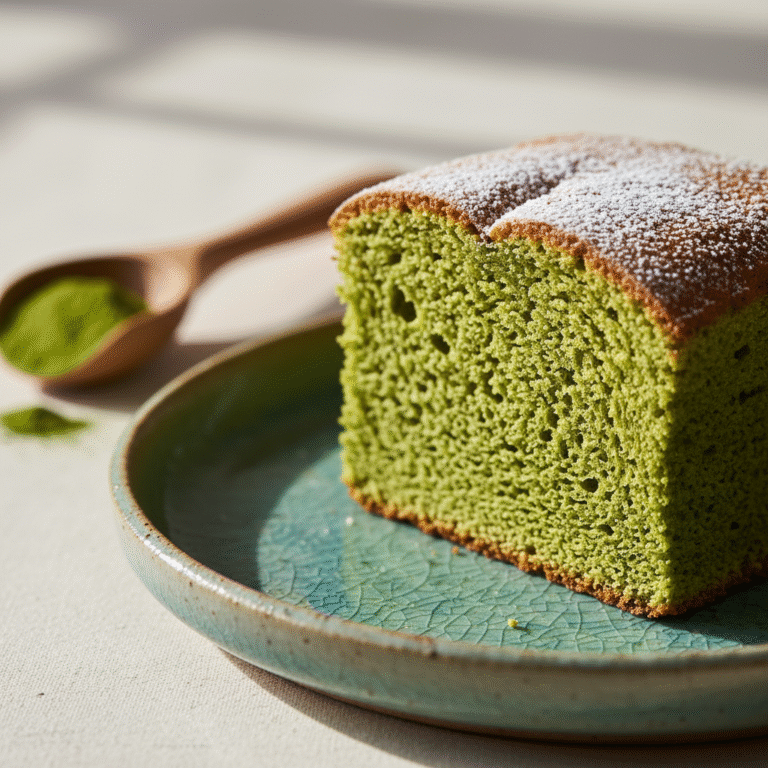
Experience the cloud-like texture of authentic Japanese baking with this vibrant Matcha Sponge Cake. Perfectly balancing earthy premium green tea with a cotton-soft, airy crumb, this recipe is the ideal base for strawberry shortcakes or a stunning tea-time treat on its own.
30 minutes
35 minutes
1 hour 15 minutes
One 8-inch round cake (8 servings)
Dessert
Baking
Japanese
Vegetarian
If you have ever wandered into the basement food hall of a Japanese department store, or ‘Depachika,’ you have likely been mesmerized by the rows of pristine, emerald-green cakes that seem to defy gravity. Japanese sponge cakes are renowned worldwide not for their density or richness, but for their incredible lightness, fine crumb, and delicate sweetness. Unlike American butter cakes, which rely heavily on creaming butter and sugar for lift, the traditional Japanese sponge (often a variation of a Genoise) relies on the mechanical aeration of eggs. This results in a texture that is often described as ‘fuwa-fuwa’ (fluffy) and ‘mochi-mochi’ (bouncy).
In this comprehensive guide, we are tackling the holy grail of Japanese home baking: the Matcha Sponge Cake. This isn’t just a vanilla cake with green tea powder stirred in; it is a carefully balanced formula designed to highlight the complex, grassy, and slightly bitter notes of premium Matcha without weighing down the batter. The magic lies in the technique. By warming the eggs and sugar before whipping, we create a stable foam that holds the flour and melted butter in suspension, resulting in a cake that rises high and stays moist for days. Whether you are planning to build a classic Japanese Christmas Cake, a rolled Swiss roll, or simply want a slice of something not-too-sweet to accompany your afternoon sencha, this recipe brings the professional techniques of Tokyo pâtissiers right into your home kitchen.
History & Origins
The story of sponge cake in Japan is a fascinating tale of culinary cross-pollination that dates back to the 16th century. It began with the arrival of Portuguese merchants and missionaries at the port of Nagasaki during the Muromachi period. These traders, known as ‘Nanban’ (southern barbarians), brought with them a distinct confection known as ‘Pão de Castela’ (bread of Castile). This early prototype was a simple mixture of eggs, flour, and sugar—ingredients that were incredibly luxurious in Japan at the time. The Japanese adopted this recipe, adapting it over centuries to suit local tastes and ingredients, eventually evolving it into ‘Kasutera’ (Castella), a dense, moist, rectangular cake that remains a specialty of Nagasaki today.
However, the round, airy sponge cake we associate with modern Japanese shortcakes (Yogashi) represents a later evolution, heavily influenced by French baking techniques introduced during the Meiji era (1868–1912) when Japan opened its borders to the West. As French pastry chefs brought the technique of the ‘Genoise’ to Japan, local bakers began to modify it. They sought a texture that was lighter and less oily than European counterparts, reducing the butter content and focusing on egg foam stability. The incorporation of Matcha—finely ground green tea powder traditionally reserved for the sacred tea ceremony—into these Western-style cakes was a natural progression in the mid-20th century. It bridged the gap between ‘Wagashi’ (traditional Japanese confectionery) and the booming demand for Western sweets. Today, the Matcha Sponge Cake stands as a symbol of modern Japanese culinary identity: respecting Western technique while honoring the ancient, earthy flavor profile of pure green tea.
Why This Recipe Works
This recipe is engineered to solve the two most common problems home bakers face with sponge cakes: a dense, rubbery texture and a lack of distinct matcha flavor. First, we utilize the ‘warm bath’ method for the eggs. By heating the eggs and sugar to approximately 104°F (40°C) before whipping, we reduce the surface tension of the eggs. This allows them to whip up to a greater volume and creates a more stable foam structure (the ribbon stage) that is less likely to deflate when the flour is folded in. This is the secret to that professional ‘cotton-soft’ height.
Secondly, the inclusion of a small amount of honey or ‘mizuame’ (Japanese starch syrup) is a nod to traditional Kasutera techniques. This invert sugar retains moisture far better than granulated sugar alone, ensuring the cake remains soft even a day after baking. Furthermore, we dissolve the Matcha powder into the warm milk and butter mixture rather than sifting it with the dry flour. Fat carries flavor. by ‘blooming’ the matcha in the warm dairy, we intensify the color and prevent the dry powder from clumping or drying out the batter, resulting in a consistently vibrant green crumb with no bitter pockets.
Why You’ll Love This Recipe
- ✓Achieves the authentic ‘fuwa-fuwa’ (fluffy) texture found in Japanese bakeries.
- ✓Uses honey to retain moisture for days without drying out.
- ✓Vibrant natural green color without artificial dyes.
- ✓Perfect structural integrity for layering with whipped cream and fruit.
- ✓Balanced sweetness that lets the earthy matcha flavor shine.
- ✓Detailed steps ensure success even for sponge cake beginners.
Equipment You’ll Need
- ✓Stand mixer or electric hand mixer
- ✓8-inch (20cm) round cake pan
- ✓Parchment paper
- ✓Digital kitchen scale
- ✓Fine-mesh sieve
- ✓Rubber spatula
- ✓Saucepan (for bain-marie)
- ✓Instant-read thermometer (optional)
Ingredients
- ✓4 large eggs (approx. 200g without shell), room temperature
- ✓120g granulated sugar
- ✓1 tablespoon honey
- ✓120g cake flour (low protein flour)
- ✓15g high-quality Matcha powder (culinary or premium grade)
- ✓30g unsalted butter
- ✓45ml whole milk
- ✓1/2 teaspoon vanilla extract (optional)
Instructions
- 1. Prep the Pan and Oven: Preheat your oven to 340°F (170°C). Line the bottom and sides of an 8-inch round cake pan with parchment paper. Do not grease the sides of the pan if you want the cake to climb higher, but lining with paper is safer for removal.
- 2. Sift Dry Ingredients: Sift the cake flour twice to ensure it is incredibly airy. Set aside.
- 3. Prepare the Wet Mixture: In a small bowl, combine the butter and milk. Microwave briefly or place in a hot water bath until the butter is fully melted and the mixture is warm. Whisk in the Matcha powder into this warm milky butter until smooth and clump-free. Keep this mixture warm (about 104°F/40°C).
- 4. Warm the Eggs: Crack the eggs into the bowl of your stand mixer. Add the granulated sugar and honey. Place the bowl over a saucepan of simmering water (bain-marie), ensuring the bottom of the bowl doesn’t touch the water. Whisk continuously until the egg mixture reaches 104°F (40°C) and the sugar dissolves.
- 5. Whip to Ribbon Stage: Remove from heat. Immediately beat the eggs on high speed. You are looking for the ‘ribbon stage’—when you lift the whisk, the batter should fall in thick trails that stay on the surface for 3 seconds before disappearing. This usually takes 5-8 minutes. Once achieved, reduce speed to low and mix for 1 minute to pop large air bubbles and refine the texture.
- 6. Fold in Flour: Sift the flour over the egg mixture in two batches. After the first addition, fold gently with a spatula using a ‘J’ motion (cut down the center, scoop up the bottom, and turn the bowl). Repeat with the second batch until no dry flour remains. Be gentle to keep the air in.
- 7. Temper the Batter: Take a scoop of the batter (about 1/2 cup) and add it to the warm matcha/butter/milk mixture. Mix this vigorously until well combined. This ‘sacrificial’ batter brings the heavy fat mixture closer in density to the main batter.
- 8. Final Fold: Pour the green matcha mixture back into the main batter bowl. Fold gently but thoroughly until the color is uniform and the batter is glossy. Do not over-mix.
- 9. Bake: Pour the batter into the prepared pan from a height of about 8 inches (this helps pop large bubbles). Tap the pan on the counter once firmly to release trapped air. Bake for 30-35 minutes, or until a toothpick inserted comes out clean and the top springs back when touched.
- 10. Cooling: Remove from the oven and immediately drop the pan from a height of 6 inches onto the counter (this prevents shrinking by releasing steam pressure). Remove the cake from the pan and let it cool upside down on a wire rack if possible, or right side up if the structure looks delicate. Peel off parchment only after cooling.
Expert Cooking Tips
- ✓Room Temperature is Key: Cold eggs will not whip up to the volume needed for a fluffy sponge. Always warm them as instructed.
- ✓Invest in Matcha: The color and flavor of your cake depend entirely on the quality of your powder. Avoid ‘latte mix’ which has sugar. Use 100% pure Matcha.
- ✓The Toothpick Test: Sponge cakes dry out quickly if overbaked. Check at the 30-minute mark. Moist crumbs on the toothpick are okay; wet batter is not.
- ✓Don’t Skip the Sifting: Sifting the flour twice introduces air and prevents heavy lumps from sinking your batter.
- ✓Mizuame Substitute: If you have authentic Japanese Mizuame, use it instead of honey for a more traditional, cleaner sweetness.
- ✓The Drop: Dropping the pan after baking sounds violent, but it is a standard Japanese technique (‘shocking’ the cake) to stabilize the structure as it cools.
Substitutions and Variations
If you cannot find **Cake Flour**, you can make a substitute by measuring 1 cup of All-Purpose flour, removing 2 tablespoons, and replacing them with 2 tablespoons of cornstarch. Sift this mixture 4-5 times to aerate it thoroughly. For the **Matcha**, while ceremonial grade provides the most vibrant green color, a high-quality ‘premium culinary’ grade is often better for baking as its flavor is strong enough to stand up to the sugar and eggs. Do not use cheap, brownish culinary matcha, or your cake will look muddy. If you need to avoid **Honey**, you can substitute it with corn syrup, agave nectar, or simply replace it with an equal weight of extra sugar, though the cake may be slightly less moist. For a **Dairy-Free** version, substitute the butter with a neutral oil (like grapeseed) and the milk with soy or almond milk, though the flavor profile will lack the richness of butter.
Common Mistakes to Avoid
The most common mistake is **under-whipping the eggs**. Beginners often stop when the eggs look foamy, but they must be thick, pale, and glossy, tripling in volume. If the eggs aren’t whipped enough, the cake will be dense and rubbery. Conversely, **over-folding the flour** is a disaster; every fold knocks air out. Stop exactly when the flour streaks disappear. Another issue is **oven temperature accuracy**; if your oven runs hot, the cake will rise rapidly and then collapse or burn on top before the center is cooked. Use an oven thermometer. Finally, allowing the **butter/milk mixture to cool** too much before adding it can cause it to sink to the bottom of the bowl, creating a dense, rubbery layer at the base of your cake.
Serving Suggestions
This cake is traditionally served as a ‘Shortcake’ in Japan. Slice the sponge horizontally into two or three layers. Fill and frost with lightly sweetened Chantilly cream (whipped cream with sugar and a drop of vanilla) and fresh strawberries or chestnuts. The acidity of strawberries cuts through the earthy matcha perfectly. Alternatively, serve a thick slice plain with a dusting of powdered sugar and a side of ‘Anko’ (sweet red bean paste) for a classic Japanese tea-time pairing. It pairs beautifully with hot Sencha or Hojicha tea.
Storage and Reheating Tips
Sponge cakes dry out easily because they have low fat content. Once the cake is completely cool, wrap it tightly in plastic wrap immediately. It is actually best eaten the next day, as the moisture redistributes and the matcha flavor deepens. Store at room temperature for up to 2 days, or in the refrigerator for up to 4 days (if frosted). For long-term storage, wrap the whole cake or individual slices in plastic wrap followed by foil and freeze for up to one month. Thaw at room temperature for 30 minutes before serving.
Nutrition Facts (Estimated)
| Serving Size | 1 slice |
| Calories | 240 |
| Fat | 9g |
| Saturated Fat | 5g |
| Unsaturated Fat | 3g |
| Trans Fat | 0g |
| Cholesterol | 115mg |
| Sodium | 45mg |
| Carbohydrates | 34g |
| Fiber | 1g |
| Sugar | 22g |
| Protein | 5g |
Frequently Asked Questions
Why did my sponge cake collapse after taking it out of the oven?
Collapsing usually happens for two reasons: under-baking (the internal structure wasn’t set) or not ‘shocking’ the cake. Dropping the pan onto the counter immediately after removal helps release trapped steam that pulls the cake inward as it cools.
Can I reduce the sugar in this recipe?
I do not recommend reducing the sugar significantly. Sugar is not just for flavor here; it provides structural stability to the egg foam and retains moisture. Reducing it can lead to a dry, rubbery cake that doesn’t rise properly.
My cake turned out brown instead of green. Why?
This is likely due to the quality of your Matcha or the oven temperature. Low-grade matcha oxidizes and turns brown when heated. Also, if the oven is too hot, the crust will brown deeply. You can cover the top with foil halfway through baking if it browns too quickly.
Can I bake this in a different size pan?
Yes. For a 6-inch pan, halve the recipe. For a 9-inch pan, multiply the ingredients by 1.5. Adjust baking time accordingly (less time for smaller, more for larger).
What is the difference between Castella and this Sponge Cake?
Castella (Kasutera) uses bread flour (high gluten) and no oil/butter, relying solely on sugar and eggs for a chewy, moist texture. This recipe is a Genoise-style sponge using cake flour and butter for a lighter, fluffier crumb suitable for layer cakes.
Can I use hand mixer instead of a stand mixer?
Absolutely. A hand mixer works perfectly. It may just take a few minutes longer to reach the ribbon stage compared to a powerful stand mixer.
How do I slice the cake horizontally without it crumbling?
Chill the cake in the fridge for at least an hour before slicing. Cold cakes are firmer and produce fewer crumbs. Use a long, serrated bread knife and a sawing motion.
Why does my cake smell like eggs?
A strong egg smell can result from using older eggs or under-baking. The vanilla extract helps mask this, and ensuring the cake is fully baked eliminates the raw egg aroma. High-quality matcha also overpowers egg scents.
Conclusion
Mastering the Japanese Matcha Sponge Cake is a rewarding journey that elevates your baking repertoire to a professional level. The result—a tall, proud cake with the sophisticated aroma of green tea and a texture lighter than air—is unlike anything you will find in a standard supermarket bakery. It is a testament to the Japanese philosophy of refinement and balance. Whether you dress it up with cream and fruit for a celebration or enjoy it simply with a cup of tea, this cake brings a moment of Zen to your day. Happy baking!