Ultimate Festive Christmas Yule Log Cake With Cream Cheese Frosting
Festive Christmas Yule Log Cake With Cream Cheese Frosting Recipe
Create a show-stopping holiday centerpiece with this classic Bûche de Noël recipe. Featuring a light-as-air chocolate sponge cake rolled with a luscious, tangy cream cheese filling and frosted to resemble a rustic log, this dessert is the definition of Christmas magic on a plate.
45 minutes
15 minutes
2 hours
10-12 servings
Dessert
Baking
French/American
Vegetarian
There is perhaps no dessert more synonymous with the magic of Christmas Eve than the Bûche de Noël, or Yule Log Cake. It is a confection that bridges the gap between rustic tradition and elegant patisserie, serving as the crowning jewel of the holiday table. This specific recipe elevates the classic concept by pairing a deep, rich chocolate sponge with a velvety cream cheese frosting. While many traditional recipes utilize heavy buttercreams or intense ganaches, the inclusion of cream cheese adds a sophisticated tang that cuts through the sweetness of the chocolate and sugar, creating a perfectly balanced bite that feels indulgent without being cloying.
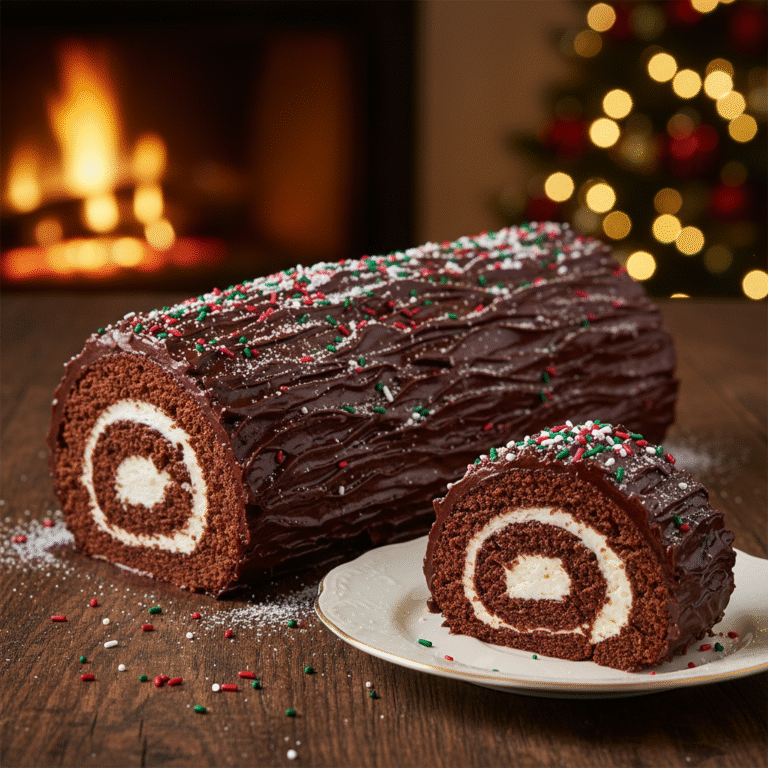
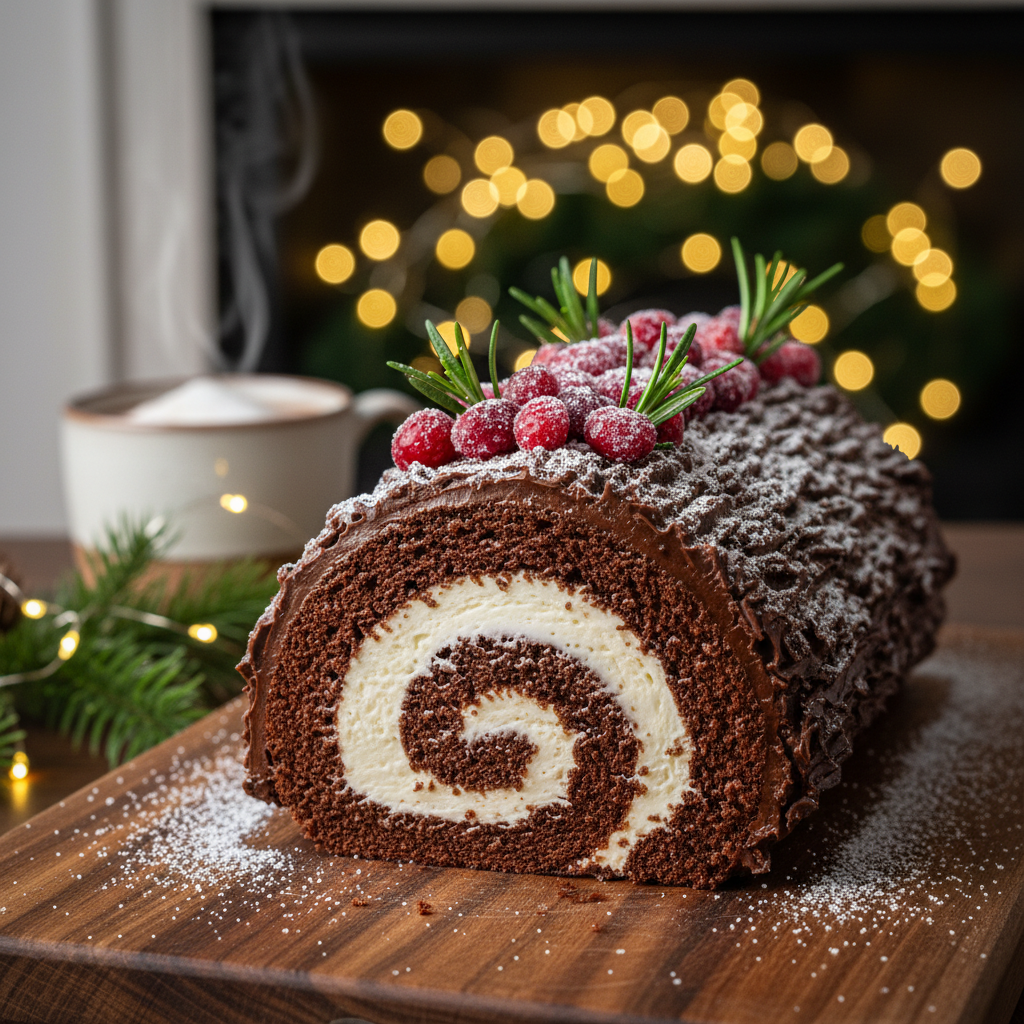
For many home bakers, the Yule Log is an intimidating project, shrouded in the fear of the dreaded ‘crack’ during rolling. However, this guide is designed to demystify the process. We utilize a sponge method that prioritizes flexibility and moisture, ensuring a tight, beautiful spiral every time. The texture of the cake is cloud-like yet sturdy enough to hold the filling, and the frosting is manipulated to look like textured tree bark, dusted with powdered sugar snow. Whether you are hosting a grand family gathering or looking for a cozy baking project to tackle while the snow falls outside, this Festive Christmas Yule Log is more than just a cake; it is an edible celebration of the season, evoking memories of warmth, family, and the joy of handmade treats.
History & Origins
The history of the Yule Log cake is a fascinating journey from the hearth to the bakery window, deeply rooted in European folklore and tradition. Long before it became a sponge cake, the ‘Yule Log’ was a literal wooden log. Dating back to Europe’s Iron Age, specifically within Celtic culture, families would gather to celebrate the Winter Solstice—the longest night of the year. To mark the return of the sun, a massive log, often decorated with holly, pinecones, or ivy, would be dragged into the home and burned in the hearth. The burning of the log was a ceremonial event; the ashes were believed to offer protection against evil spirits and lightning strikes for the coming year, and the warmth symbolized the light conquering the darkness.
As hearths became smaller and cast-iron stoves replaced open fireplaces in the 19th century, burning a giant log became impractical for many households. However, the symbolism remained beloved. It was in Paris, during the late 1800s, that imaginative pastry chefs began to create a culinary homage to this tradition. While the exact inventor is debated—some attribute it to Pierre Lacam in the 1890s—the *Bûche de Noël* became a staple in Parisian bakeries. These early cakes were made of genoise sponge, rolled with buttercream, and decorated with marzipan mushrooms to mimic the forest floor. The cake allowed urban families to keep the ancient tradition alive in a delicious, edible form. Today, the Yule Log is a global icon of Christmas baking, with infinite variations in flavor, but the spirit of the solstice fire remains in every spiral.
Why This Recipe Works
This recipe succeeds where others fail primarily due to the structural integrity of the sponge and the stability of the cream cheese filling. First, the sponge cake relies on a high ratio of whipped eggs to flour. By whipping the eggs to the ‘ribbon stage,’ we incorporate a massive amount of air, which acts as a natural leavening agent. This results in a cake that is incredibly light but also elastic. Unlike denser butter cakes, this sponge can bend without breaking, provided it is handled correctly while warm. The addition of a small amount of oil ensures the cake remains moist even after being stored in the refrigerator, preventing that dry, cardboard-like texture often found in store-bought Swiss rolls.
Secondly, the cream cheese frosting is the secret weapon. Traditional buttercream can often become too soft at room temperature or too hard in the fridge, making the cake difficult to slice cleanly. Cream cheese, blended with butter and confectioners’ sugar, offers a superior consistency. It is firm enough to hold the spiral shape of the cake but soft enough to provide a creamy mouthfeel. The slight acidity of the cheese also balances the cocoa, enhancing the chocolate flavor rather than masking it. Finally, the ‘hot roll’ technique—rolling the cake in a towel immediately after baking—trains the gluten strands to accept the spiral shape, virtually eliminating the risk of major cracking when you fill it later.
Why You’ll Love This Recipe
- ✓Foolproof rolling technique prevents cracking
- ✓Tangy cream cheese filling balances the sweet chocolate
- ✓Rustic ‘bark’ decoration requires no advanced piping skills
- ✓Can be made a day in advance for stress-free hosting
- ✓Visual showstopper perfect for holiday photos
- ✓Light, airy sponge texture that isn’t overly heavy
Equipment You’ll Need
- ✓10×15 inch Jelly Roll Pan
- ✓Electric Stand Mixer or Hand Mixer
- ✓Parchment Paper
- ✓Clean Kitchen Towel (lint-free)
- ✓Sifter or Fine Mesh Sieve
- ✓Offset Spatula
- ✓Wire Cooling Rack
- ✓Mixing Bowls
Ingredients
- ✓6 large eggs, room temperature
- ✓1/2 cup granulated sugar (for yolks)
- ✓1/4 cup granulated sugar (for whites)
- ✓1/3 cup unsweetened cocoa powder
- ✓3/4 cup cake flour (or all-purpose flour)
- ✓1 tsp baking powder
- ✓1/2 tsp salt
- ✓1 tsp vanilla extract
- ✓2 tbsp vegetable oil
- ✓1/4 cup strong brewed coffee (cooled)
- ✓8 oz cream cheese, softened (Filling)
- ✓1/2 cup unsalted butter, softened (Filling)
- ✓3 cups powdered sugar (Filling/Frosting)
- ✓1 tsp vanilla extract (Filling)
- ✓1/2 cup cocoa powder (for Frosting only)
- ✓Fresh rosemary sprigs and cranberries for garnish
Instructions
- 1. Preheat your oven to 350°F (175°C). Grease a 10×15 inch jelly roll pan and line it with parchment paper, leaving a slight overhang on the sides. Grease the parchment paper as well.
- 2. Prepare the dry ingredients: In a medium bowl, sift together the cake flour, 1/3 cup cocoa powder, baking powder, and salt. Set aside.
- 3. Separate the eggs. Place the yolks in a large mixing bowl and the whites in the bowl of a stand mixer.
- 4. Beat the egg yolks with 1/2 cup granulated sugar on high speed until pale and thick (about 3 minutes). Whisk in the vanilla extract, vegetable oil, and brewed coffee.
- 5. Gently fold the dry ingredients into the yolk mixture until just combined. Do not overmix.
- 6. Whip the egg whites: Beat the egg whites on medium speed until soft peaks form. Gradually add the remaining 1/4 cup granulated sugar and continue beating until stiff, glossy peaks form.
- 7. Lighten the batter: Gently fold about 1/3 of the egg whites into the chocolate batter to lighten it. Then, carefully fold in the remaining egg whites, being careful not to deflate the air bubbles.
- 8. Spread the batter evenly into the prepared pan. Bake for 12-15 minutes, or until the top springs back when lightly touched.
- 9. The Rolling Step (Crucial): While the cake is baking, lay a clean kitchen towel on the counter and dust it generously with cocoa powder or powdered sugar. As soon as the cake comes out of the oven, turn it onto the towel. Peel off the parchment paper carefully. Starting at a short end, roll the warm cake up with the towel inside. Let it cool completely in this rolled shape on a wire rack.
- 10. Make the filling: Beat the softened cream cheese and butter until smooth. Gradually add powdered sugar and vanilla. Divide the frosting: keep 2/3 white for the filling. To the remaining 1/3, add 1/2 cup cocoa powder to create the chocolate ‘bark’ frosting.
- 11. Assembly: Once the cake is cool, gently unroll it. Spread the white cream cheese filling evenly over the surface, leaving a small border. Re-roll the cake (without the towel this time).
- 12. Decoration: Cut a small diagonal slice off one end of the log and attach it to the side of the cake using a bit of frosting to simulate a branch. Frost the entire exterior with the chocolate frosting. Use a fork to drag lines through the frosting to create a bark texture.
- 13. Garnish with fresh rosemary sprigs (to look like pine) and cranberries. Dust with powdered sugar to resemble fresh snow before serving.
Expert Cooking Tips
- ✓Room Temperature Eggs: Ensure your eggs are truly at room temperature; they whip up to a greater volume, which is essential for a sponge cake.
- ✓Don’t Overbake: The cake is thin and bakes fast. If you overbake it, it will lose flexibility and crack when you try to roll it.
- ✓The Towel Trick: Do not skip the towel rolling step or wait for the cake to cool. The ‘muscle memory’ of the cake is formed while the gluten is hot.
- ✓Sifting is Key: Always sift your cocoa powder and flour to prevent lumps in the delicate batter.
- ✓Cool Completely: Do not try to fill the cake while it is even slightly warm, or the cream cheese filling will melt and ooze out.
- ✓Clean Cuts: To get those perfect spiral slices, use a sharp knife dipped in hot water and wiped dry between each cut.
Substitutions and Variations
This recipe is quite adaptable to dietary needs and pantry availability. If you do not have cake flour, you can make a substitute by measuring 3/4 cup of all-purpose flour, removing 1.5 tablespoons, and replacing it with cornstarch. For a gluten-free version, use a high-quality 1:1 gluten-free baking flour blend that contains xanthan gum; the texture will be slightly different but still delicious. If you want a different flavor profile, you can replace the coffee in the batter with water or a liqueur like Grand Marnier or Kahlúa. For the filling, if you find cream cheese too tangy, you can swap it for a mascarpone cheese filling or a traditional vanilla buttercream. For a dairy-free version, use plant-based butter and cream cheese alternatives, though ensure they are firm blocks, not tubs, to maintain stability.
Common Mistakes to Avoid
The most common mistake with a Yule Log is letting the cake cool before rolling it. If the cake cools flat, the gluten structure sets, and forcing it to roll later will cause it to snap and break. Another frequent error is over-whipping the egg whites to the point where they become dry and clumpy; they should be stiff but glossy. Deflating the batter is also a risk; when folding the whites into the chocolate mixture, use a gentle hand and a ‘cut and fold’ motion rather than stirring vigorously. Finally, rushing the cooling process can be disastrous; if the cake is warm when you add the cream cheese frosting, you will end up with a soupy mess rather than a defined spiral.
Serving Suggestions
Serve the Yule Log on a long rectangular platter or a wooden board to enhance the rustic aesthetic. Since the cake is rich, thin slices are usually sufficient. It pairs beautifully with hot beverages that contrast the cool, creamy filling, such as freshly brewed dark roast coffee, an espresso, or a hot toddy. For a dessert course, accompany each slice with a dollop of unsweetened whipped cream or a side of tart raspberry coulis to cut through the richness of the chocolate and cream cheese. If you want to be extra festive, serve it alongside a scoop of peppermint ice cream.
Storage and Reheating Tips
Because this cake contains cream cheese, it must be stored in the refrigerator. It can be left out for display for about 2 hours, but any longer and the frosting may become too soft and safety becomes a concern. To store leftovers, press a piece of plastic wrap directly against the cut face of the cake to prevent the sponge from drying out, then loosely cover the rest of the cake. It will keep in the fridge for up to 3-4 days. The cake actually freezes quite well; you can freeze the whole log (without the rosemary garnish) by wrapping it tightly in plastic wrap and then foil for up to one month. Thaw overnight in the refrigerator before serving.
Nutrition Facts (Estimated)
| Serving Size | 1 slice |
| Calories | 420 |
| Fat | 24g |
| Saturated Fat | 14g |
| Unsaturated Fat | 8g |
| Trans Fat | 0g |
| Cholesterol | 115mg |
| Sodium | 210mg |
| Carbohydrates | 48g |
| Fiber | 2g |
| Sugar | 38g |
| Protein | 6g |
Frequently Asked Questions
Why did my cake crack when I unrolled it?
Cracking usually happens if the cake was overbaked (making it dry) or if it wasn’t rolled immediately when it came out of the oven. However, don’t panic! The frosting covers all sins. Just patch it together with frosting and coat it heavily.
Can I make this cake ahead of time?
Yes, in fact, it’s often better the next day as the moisture from the filling softens the sponge slightly. You can fully assemble and decorate it (minus fresh herbs) up to 24 hours before serving.
Can I use store-bought frosting?
Technically yes, but store-bought frosting is often much sweeter and thinner than homemade cream cheese frosting. If you use it, you might find the cake too cloying and the filling might squish out more easily.
What if I don’t have a jelly roll pan?
A jelly roll pan (10×15 inches) is ideal. A standard 9×13 pan is too small and will result in a cake that is too thick to roll. You can use a half-sheet pan (13×18), but the cake will be thinner and bake faster, so watch it closely.
Does the cake taste like coffee?
No. The small amount of coffee enhances the chocolate flavor, making it taste more ‘chocolatey,’ but it does not impart a distinct coffee taste. You can use hot water if you prefer to avoid caffeine entirely.
How do I get the bark texture?
It is surprisingly easy! Apply a thick layer of chocolate frosting, then take a standard dinner fork and drag the tines through the frosting in slightly wavy, irregular lines.
Can I fill it with something else?
Absolutely. While cream cheese is recommended, you can use chocolate ganache, whipped cream (stabilized with gelatin), or a fruit preserve and cream mixture.
Is the towel method sanitary?
Yes, as long as you use a freshly laundered, lint-free kitchen towel. The heat of the cake is not an issue. If you are uncomfortable with a towel, you can try rolling it in parchment paper, though parchment is stiffer and can sometimes cause creases.
Conclusion
Mastering the Festive Christmas Yule Log Cake is a badge of honor for any home baker, but as you can see, it is far from an impossible task. By following the steps carefully—especially the rolling technique—you can produce a bakery-quality dessert that tastes as good as it looks. The combination of the tender chocolate sponge and the tangy, rich cream cheese frosting creates a flavor profile that is sophisticated yet universally loved. So, put on your favorite holiday playlist, preheat the oven, and get ready to impress your friends and family with a dessert that captures the very essence of the holiday season. Happy baking!