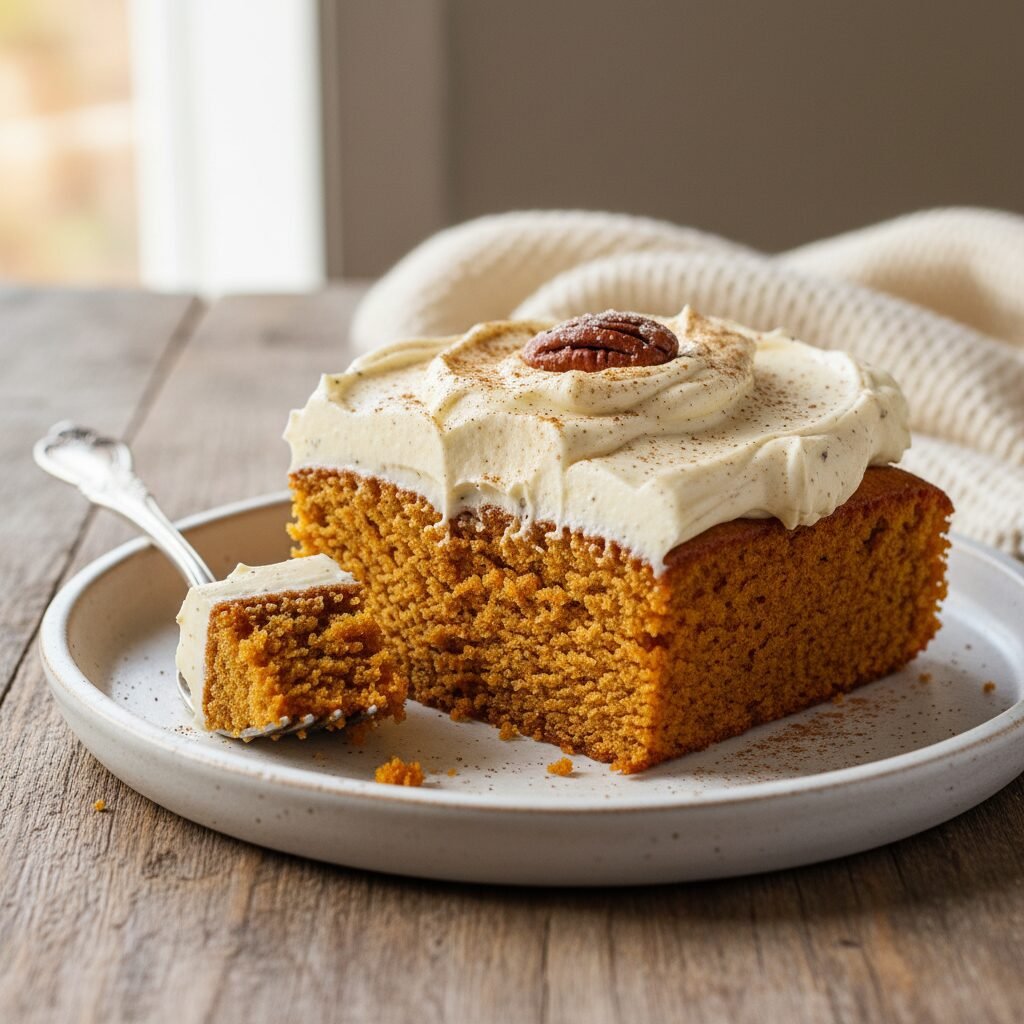
The Best Moist Gluten Free Pumpkin Cake With Vanilla Buttercream
Moist Gluten Free Pumpkin Cake With Vanilla Buttercream Recipe
Discover the ultimate fall dessert with this incredibly moist Gluten-Free Pumpkin Cake. Infused with warm spices and topped with a luscious, cloud-like vanilla bean buttercream, this recipe defies the dry texture often associated with gluten-free baking, delivering a tender crumb that melts in your mouth.
20 minutes
35 minutes
1 hour 15 minutes
12-15 servings
Dessert
Baking
American
Gluten-Free
There is a pervasive myth in the culinary world that gluten-free baking requires a sacrifice in texture. Too often, gluten-free cakes are stigmatized as being crumbly, dry, or possessing a gritty mouthfeel that instantly gives away their dietary classification. This recipe for Moist Gluten-Free Pumpkin Cake with Vanilla Buttercream is here to shatter those misconceptions once and for all. It is not just ‘good for being gluten-free’; it is simply an outstanding cake, period.
As the leaves begin to turn and the air grows crisp, the craving for warm, aromatic spices takes over. This cake is the embodiment of autumn comfort. We utilize a generous amount of pumpkin purée, which acts as a powerful humectant, locking moisture into the batter and ensuring that every bite remains soft and tender for days. The batter is spiced with a robust blend of cinnamon, nutmeg, ginger, and cloves—the quintessential pumpkin pie spice mix—which permeates the kitchen with an intoxicating fragrance as it bakes.
To balance the deep, earthy sweetness of the pumpkin and brown sugar, we pair the sponge with a classic, fluffy vanilla buttercream. The frosting is whipped to perfection, offering a creamy, sweet counterpoint to the dense, spice-laden cake. Whether you are baking for a celiac family member, a gluten-intolerant friend, or simply looking for a crowd-pleasing dessert for your Thanksgiving table, this cake promises to deliver satisfaction. It is a celebration of texture and flavor, proving that with the right ingredients and techniques, gluten-free treats can be just as decadent and delightful as their traditional counterparts.
History & Origins
The history of the pumpkin cake is deeply rooted in the agricultural history of the Americas. Pumpkins, or ‘pepon’ as the Greeks called large melons, are actually native to North America. Indigenous peoples have been cultivating pumpkins for at least 7,500 years, long before the arrival of European settlers. Originally, pumpkins were roasted over hot coals or stewed, serving as a savory staple rather than a sweet treat.
When European colonists arrived, they adapted their own cooking methods to this new gourd. One of the earliest precursors to pumpkin cake and pie was a dish where colonists would slice off the top of a pumpkin, remove the seeds, fill the cavity with milk, spices, and honey, and roast it whole in hot ashes. By 1796, Amelia Simmons published ‘American Cookery,’ the first American cookbook, which contained a recipe for ‘Pompkin’ pudding baked in a crust—the great-grandmother of the modern pumpkin pie.
However, the pumpkin *cake* as we know it is a more modern evolution, gaining popularity in the 20th century with the advent of chemical leaveners like baking powder and baking soda, which allowed for lighter, fluffier loaves and sheet cakes. The introduction of canned pumpkin purée by Libby’s in 1929 revolutionized home baking, making pumpkin desserts accessible year-round without the labor of roasting and mashing fresh gourds.
The gluten-free evolution of this history is even more recent, gaining traction in the early 2000s as awareness of Celiac disease and gluten sensitivity grew. Early gluten-free adaptations were often dense and unpalatable, but the development of sophisticated 1-to-1 flour blends containing rice flour, potato starch, and tapioca starch has allowed modern bakers to recreate historic favorites like this pumpkin cake with indistinguishable results.
Why This Recipe Works
This recipe succeeds where many gluten-free cakes fail due to a specific combination of chemistry and ingredient selection. The primary challenge in gluten-free baking is the lack of a structural protein network (gluten) which usually traps air and provides chew. To compensate, we rely on a high-quality 1-to-1 gluten-free flour blend that includes xanthan gum. The xanthan gum mimics the elasticity of gluten, providing the necessary structure to hold the cake together without it crumbling.
Secondly, the choice of fat is crucial. While butter adds flavor, oil is superior for texture in cakes that contain heavy purées. Oil remains liquid at room temperature, which coats the flour proteins more effectively than butter, resulting in a sensation of greater moisture. When combined with pumpkin purée—which is roughly 90% water and high in fiber—the result is a cake that is incredibly difficult to over-bake or dry out. The pumpkin fiber holds onto water during the baking process, releasing it slowly as the cake cools.
Finally, the use of both brown and white sugar plays a role beyond sweetness. Brown sugar contains molasses, which is acidic. This acidity reacts with the baking soda to create carbon dioxide, giving the cake a powerful lift and a lighter crumb, countering the heavy weight of the pumpkin purée. This balance of lift, structure, and hydration creates the perfect moist cake.
Why You’ll Love This Recipe
- ✓Incredibly moist texture that stays fresh for days
- ✓Rich, warm autumn spice profile
- ✓Silky smooth vanilla buttercream frosting
- ✓Simple one-bowl method for the cake batter
- ✓Completely gluten-free and celiac-friendly
- ✓Perfect for holidays and meal prep
Equipment You’ll Need
- ✓9×13 inch baking pan or two 8-inch round pans
- ✓Stand mixer or electric hand mixer
- ✓Large mixing bowl
- ✓Medium mixing bowl
- ✓Whisk
- ✓Rubber spatula
- ✓Wire cooling rack
- ✓Measuring cups and spoons
- ✓Parchment paper
Ingredients
- ✓2 cups Gluten-Free All-Purpose Flour Blend (ensure it contains xanthan gum)
- ✓1 1/2 teaspoons baking powder
- ✓1 teaspoon baking soda
- ✓1 tablespoon pumpkin pie spice
- ✓1 1/2 teaspoons ground cinnamon
- ✓1/2 teaspoon salt
- ✓1 cup vegetable oil or canola oil
- ✓4 large eggs, room temperature
- ✓1 cup granulated white sugar
- ✓3/4 cup light brown sugar, packed
- ✓1 can (15 oz) pure pumpkin purée (not pumpkin pie filling)
- ✓1 teaspoon pure vanilla extract
- ✓1 cup unsalted butter, softened to room temperature (for frosting)
- ✓4 cups powdered sugar, sifted (for frosting)
- ✓2-3 tablespoons heavy cream or milk (for frosting)
- ✓2 teaspoons vanilla bean paste or vanilla extract (for frosting)
- ✓Pinch of salt (for frosting)
Instructions
- Preheat your oven to 350°F (175°C). Grease a 9×13 inch baking pan (or two 8-inch round pans) and line the bottom with parchment paper for easy removal.
- In a medium bowl, whisk together the gluten-free flour, baking powder, baking soda, pumpkin pie spice, cinnamon, and salt. Ensure there are no clumps of baking soda or baking powder. Set aside.
- In a large mixing bowl, whisk together the oil, granulated sugar, brown sugar, eggs, pumpkin purée, and vanilla extract until the mixture is smooth and fully combined.
- Gradually add the dry ingredients to the wet ingredients. Use a rubber spatula to fold the mixture together gently. Stir just until no streaks of flour remain. Do not overmix, although this is less risky with gluten-free flour, it ensures the best texture.
- Pour the batter into the prepared baking pan(s) and smooth the top with an offset spatula to ensure an even bake.
- Bake in the preheated oven for 30 to 35 minutes. Test for doneness by inserting a toothpick into the center of the cake; it should come out clean or with just a few moist crumbs attached.
- Remove the cake from the oven and allow it to cool in the pan for about 15 minutes. Then, carefully transfer the cake to a wire rack to cool completely. The cake must be absolutely cool before frosting, or the buttercream will melt.
- While the cake cools, prepare the vanilla buttercream. In the bowl of a stand mixer fitted with the paddle attachment (or using a hand mixer), beat the softened butter on medium-high speed for 5 minutes until it is pale and creamy.
- Reduce the mixer speed to low and gradually add the powdered sugar, one cup at a time. Once all sugar is incorporated, increase the speed to high and beat for another 2 minutes.
- Add the vanilla bean paste (or extract), a pinch of salt, and 1 tablespoon of heavy cream. Beat on medium speed. If the frosting is too stiff, add more cream one tablespoon at a time until you reach a fluffy, spreadable consistency.
- Once the cake is fully cooled, spread a thick layer of buttercream over the top using an offset spatula or the back of a spoon. Create swirls for a rustic look.
- Slice into squares and serve immediately. Optional: garnish with a dusting of cinnamon or candied pecans.
Expert Cooking Tips
- ✓Ensure all refrigerated ingredients, especially eggs and butter, are at room temperature before starting. This helps them emulsify properly.
- ✓Weigh your flour if possible. Gluten-free flours can be dense; scooping directly can pack too much flour into the cup. Use the ‘spoon and level’ method if you don’t have a scale.
- ✓Do not use ‘Pumpkin Pie Filling’. Make sure the can says ‘100% Pure Pumpkin’. Pie filling has added sugar and thickeners that will ruin the recipe.
- ✓If your gluten-free flour blend does not contain xanthan gum, add 1 teaspoon of xanthan gum to the dry ingredients.
- ✓Let the cake cool completely. Gluten-free baked goods often need time to ‘set’ their structure as they cool. Cutting it while hot may result in a gummy texture.
- ✓Sifting the powdered sugar for the frosting is non-negotiable to avoid gritty lumps in your buttercream.
Substitutions and Variations
This recipe is quite versatile if you need to accommodate other dietary restrictions or pantry limitations. For a **dairy-free version**, substitute the butter in the frosting with a high-quality vegan butter stick (not tub margarine) and use plant-based milk (like almond or oat) instead of heavy cream. The cake itself is already dairy-free as it uses oil.
If you don’t have **pumpkin pie spice**, you can make your own blend using 1.5 tsp cinnamon, 0.5 tsp nutmeg, 0.5 tsp ginger, and 0.25 tsp ground cloves or allspice.
For the **sugar**, you can use coconut sugar instead of brown sugar for a lower glycemic index, though it will slightly alter the flavor profile to be more caramel-like. We do not recommend substituting the sugar with liquid sweeteners like maple syrup or honey, as this throws off the liquid-to-dry ratio significantly.
Regarding the **flour**, this recipe was tested with ‘measure-for-measure’ or ‘1-to-1’ gluten-free blends (like King Arthur or Bob’s Red Mill). Do not attempt to use a single flour like almond flour or coconut flour alone; they have vastly different absorption rates and structural properties.
Common Mistakes to Avoid
The most common mistake with this recipe is **underbaking**. Gluten-free flours often take slightly longer to absorb moisture and set than wheat flour. If you pull the cake out too early, the center will be gummy and dense. Trust the toothpick test, but also look for the cake pulling slightly away from the edges of the pan.
Another mistake is **measuring flour incorrectly**. Dipping the measuring cup into the bag compresses the flour, leading to a dry, hard cake. Always fluff the flour with a spoon, scoop it gently into the cup, and level it off with a knife.
Finally, **frosting a warm cake** is a disaster waiting to happen. The butter in the buttercream has a melting point below body temperature. If the cake is even slightly warm to the touch, your beautiful frosting will turn into a translucent, oily glaze.
Serving Suggestions
This cake is rich and flavorful, so it pairs beautifully with beverages that can cut through the sweetness. Serve a slice with a hot cup of black coffee, an unsweetened latte, or a spiced chai tea. For a fall party, it goes wonderfully with hot apple cider.
If you want to elevate the presentation, drizzle salted caramel sauce over the frosting just before serving. A sprinkling of toasted pecans or walnuts adds a delightful crunch that contrasts with the soft texture of the cake. For a more minimalist approach, a simple dusting of cinnamon or nutmeg over the white frosting looks elegant and festive.
Storage and Reheating Tips
Because this cake is incredibly moist, it stores very well. It can be kept at **room temperature** in an airtight container for up to 3 days. If your kitchen is particularly hot or humid, it is safer to store it in the refrigerator to prevent the buttercream from melting or the pumpkin from spoiling. In the **refrigerator**, it will last for up to 5-6 days.
To **freeze**, you have two options. You can freeze the unfrosted cake layers by wrapping them tightly in plastic wrap and then foil; they will keep for 3 months. Thaw at room temperature before frosting. You can also freeze individual slices of the frosted cake. Place slices on a baking sheet in the freezer for an hour to harden the frosting, then wrap them individually in plastic wrap and place them in a freezer-safe bag. Thaw on the counter for 30 minutes before eating.
Nutrition Facts (Estimated)
| Serving Size | 1 slice |
| Calories | 480 |
| Fat | 24g |
| Saturated Fat | 10g |
| Unsaturated Fat | 12g |
| Trans Fat | 0g |
| Cholesterol | 85mg |
| Sodium | 310mg |
| Carbohydrates | 64g |
| Fiber | 3g |
| Sugar | 42g |
| Protein | 4g |
Frequently Asked Questions
Can I make this recipe into cupcakes?
Yes, absolutely! This batter works perfectly for cupcakes. Line a muffin tin with paper liners and fill them about 2/3 full. Bake at 350°F for 18-22 minutes. This recipe yields approximately 24 standard cupcakes.
Why did my cake sink in the middle?
Sinking usually happens for two reasons: underbaking or opening the oven door too early. The structure of the cake needs time to set. If you open the door to check on it before it’s mostly set, the sudden drop in temperature can cause the air bubbles to collapse.
Can I use fresh pumpkin instead of canned?
You can, but with caution. Fresh pumpkin purée often has a much higher water content than canned. If you use fresh pumpkin, roast it rather than boiling it to minimize water, and strain the purée through a cheesecloth for an hour to remove excess liquid before measuring.
Is this cake safe for people with Celiac disease?
Yes, provided you use a certified gluten-free flour blend and ensure that all your other ingredients (like spices and baking powder) are processed in a gluten-free facility to avoid cross-contamination.
Can I reduce the sugar in this recipe?
You can reduce the sugar by about 1/4 cup without disastrous results, but keep in mind that sugar contributes to moisture and texture, not just sweetness. Reducing it too much may result in a drier, bread-like texture.
Why is my buttercream grainy?
Grainy buttercream is usually caused by not sifting the powdered sugar or not beating the butter long enough before adding the sugar. Make sure your butter is truly at room temperature and beat it until pale before adding the sifted sugar.
Can I use olive oil instead of vegetable oil?
Yes, you can use olive oil, but keep in mind that extra virgin olive oil has a strong flavor. If you enjoy that flavor profile with pumpkin, go for it. Otherwise, use a ‘light’ or ‘pure’ olive oil which is more neutral.
Do I need a stand mixer for this recipe?
For the cake batter, no—a whisk and a bowl are sufficient. However, for the buttercream frosting, you really need an electric hand mixer or a stand mixer to get enough air into the butter to make it light and fluffy.
Conclusion
This Moist Gluten-Free Pumpkin Cake with Vanilla Buttercream is more than just an allergy-friendly alternative; it is a standout dessert that captures the essence of the season. With its rich, spiced flavor profile and undeniably tender crumb, it is bound to become a new tradition in your household. Whether you are an experienced gluten-free baker or trying it for the first time, this recipe is forgiving, reliable, and utterly delicious. So grab your apron, preheat the oven, and get ready to fill your home with the heartwarming scent of pumpkin spice. We hope you love every bite as much as we do!