Elegant Pink Champagne Cake with Strawberry Buttercream
Elegant Champagne Cake Recipe
This elegant Pink Champagne Cake is the ultimate celebration dessert, featuring moist, tender layers infused with a sparkling rosé reduction. Paired with a silky strawberry champagne buttercream, it offers a delicate balance of sweet vanilla and sophisticated floral notes perfect for weddings, New Year’s Eve, or special birthdays.
45 minutes
35 minutes
1 hour 20 minutes
12-14 servings
Dessert
Baking
American
Vegetarian
There is something undeniably magical about the sound of a cork popping; it signals that a moment is worth celebrating. This Elegant Pink Champagne Cake captures that effervescent joy in dessert form, transforming a glass of bubbly into a towering masterpiece of confectionery art. Unlike standard vanilla cakes, this recipe relies on the subtle, dry acidity of champagne to cut through the sweetness, resulting in a flavor profile that is sophisticated, nuanced, and utterly unforgettable. The texture is where this cake truly shines—it is incredibly soft, boasting a velvety crumb that melts in your mouth, thanks to the tenderizing properties of the wine and a careful reverse-creaming method.
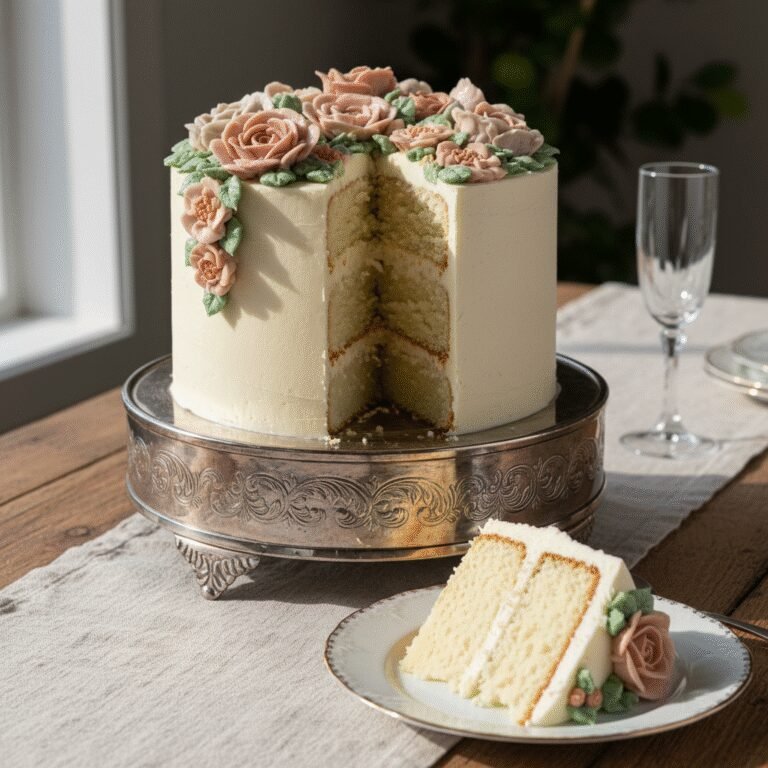
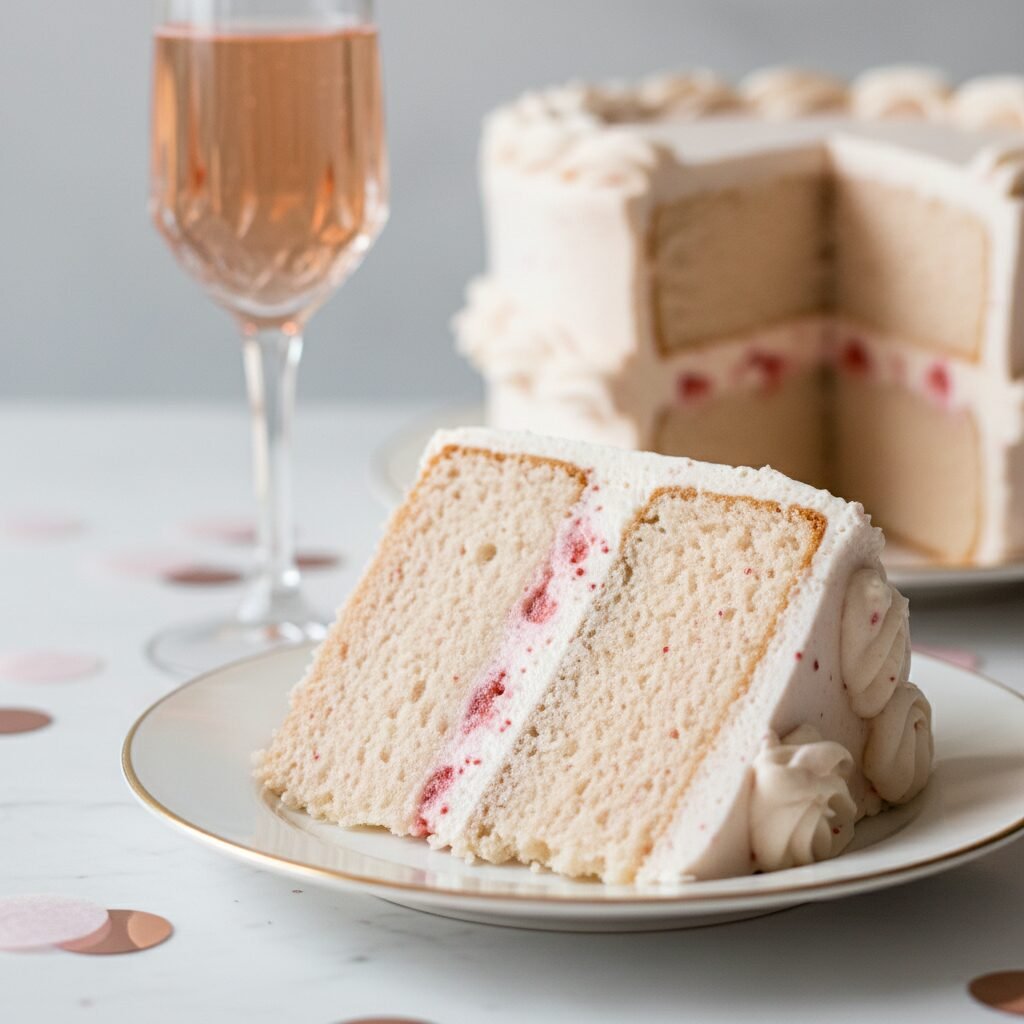
When you slice into this cake, you are greeted by a beautiful, pale blush hue that whispers of romance and festivity. It is not just a cake; it is a centerpiece that demands attention. We use a reduction of pink champagne to concentrate the flavor, ensuring that the wine’s notes aren’t lost during the baking process. This is paired with a Swiss Meringue Buttercream that is light as air, flavored with freeze-dried strawberries and a splash of more champagne, creating a strawberries-and-cream effect that is simply divine. Whether you are hosting a bridal shower, ringing in the New Year, or simply believe that Tuesday night deserves a little sparkle, this cake is your ticket to a bakery-quality result right in your own kitchen. It is the kind of dessert that guests will talk about long after the last crumb has been devoured.
History & Origins
The concept of baking with wine and spirits dates back centuries, often used as a preservative or a flavor enhancer in dense fruitcakes and puddings. However, the specific lineage of the Champagne Cake is a distinctly American phenomenon, rising to prominence during the mid-20th century. In the post-war era of the 1950s and 1960s, American home baking saw a shift towards glamour and novelty. The ‘Pink Champagne Cake’ became a fashionable staple at high-society gatherings, bridal showers, and cocktail parties, symbolizing a new era of leisure and celebration. It was the dessert equivalent of the cocktail culture that dominated the time.
Originally, many of these recipes were quite simple, often modifying chiffon or angel food cakes by substituting milk or water with champagne. The ‘pink’ aspect was frequently achieved solely through food coloring, though some adventurous bakers used pink champagne or sparkling rosé. Over the decades, the recipe has evolved from a novelty item into a gourmet standard. Modern interpretations, like the one we are making today, focus heavily on the quality of ingredients and the science of baking. We have moved away from artificial flavorings and boxed mixes to embrace the actual reduction of champagne, which intensifies the grape’s floral and yeasty characteristics. Today, the Champagne Cake is seeing a massive resurgence, fueled by Pinterest and Instagram aesthetics, where its delicate pink hue and association with luxury make it a timeless favorite for modern celebrations.
Why This Recipe Works
This recipe succeeds where many others fail because it addresses the primary challenge of baking with alcohol: flavor retention. Alcohol is volatile and evaporates quickly in the heat of the oven, often leaving behind moisture but very little taste. To combat this, we start by simmering the champagne on the stovetop to reduce it by half. This process evaporates the alcohol while concentrating the sugars and the distinct flavor profile of the wine, ensuring that the final cake actually tastes like champagne, not just plain vanilla.
Furthermore, the texture of this cake is engineered for elegance. We utilize egg whites rather than whole eggs to maintain a pristine white (or pale pink) color and a lighter, airier structure. The acidity in the champagne also interacts with the baking powder and the proteins in the flour, helping to tenderize the gluten strands. This results in a crumb that is plush and soft, rather than dense or bread-like. Finally, the choice of Swiss Meringue Buttercream over a standard American buttercream is crucial. The silkiness of the meringue base mirrors the refined nature of the champagne, providing a frosting that is not overly sweet, allowing the delicate wine notes to shine through without being overpowered by powdered sugar.
Why You’ll Love This Recipe
- ✓Infused with a concentrated champagne reduction for authentic flavor.
- ✓Incredibly tender, velvety crumb using the reverse-creaming method.
- ✓Pale blush pink color makes it visually stunning for events.
- ✓Silky strawberry champagne buttercream adds a fruity, sophisticated twist.
- ✓Perfect stability for stacking and decorating layer cakes.
- ✓Can be made ahead of time, as the flavors meld beautifully overnight.
Equipment You’ll Need
- ✓Three 8-inch round cake pans
- ✓Stand mixer with paddle and whisk attachments
- ✓Small saucepan (for reduction)
- ✓Kitchen scale
- ✓Sifter
- ✓Rubber spatula
- ✓Offset spatula
- ✓Wire cooling racks
- ✓Parchment paper
Ingredients
- ✓1 1/2 cups Pink Champagne or Sparkling Rosé (to be reduced to 3/4 cup)
- ✓3 cups Cake flour, sifted
- ✓1 tbsp Baking powder
- ✓1/2 tsp Baking soda
- ✓1 tsp Salt
- ✓1 cup Unsalted butter, room temperature
- ✓2 cups Granulated sugar
- ✓6 large Egg whites, room temperature
- ✓1 tsp Vanilla bean paste
- ✓1/2 cup Sour cream, room temperature
- ✓1 drop Pink gel food coloring (optional)
- ✓FOR THE FROSTING:
- ✓1 1/2 cups Granulated sugar
- ✓6 large Egg whites
- ✓2 cups Unsalted butter, cubed and cool but pliable
- ✓1/2 cup Freeze-dried strawberries, pulverized into powder
- ✓2 tbsp Champagne (from the bottle, not reduced)
- ✓Pinch of salt
Instructions
- 1. Reduce the Champagne: Pour 1 1/2 cups of pink champagne into a small saucepan over medium heat. Simmer gently until the liquid has reduced by half, measuring exactly 3/4 cup. Set aside to cool completely to room temperature. This is critical; do not use hot liquid in the batter.
- 2. Prep the Oven and Pans: Preheat your oven to 350°F (175°C). Grease three 8-inch round cake pans with butter, line the bottoms with parchment paper, and grease the paper. Dust with flour and tap out the excess.
- 3. Mix Dry Ingredients: In a medium bowl, whisk together the sifted cake flour, baking powder, baking soda, and salt. Set aside.
- 4. Cream Butter and Sugar: In the bowl of a stand mixer fitted with the paddle attachment, beat the butter and granulated sugar on medium-high speed for about 4-5 minutes until pale, light, and fluffy.
- 5. Add Egg Whites: Reduce speed to medium. Add the egg whites one at a time, mixing well after each addition. Scrape down the sides of the bowl as needed. Stir in the vanilla bean paste.
- 6. Combine Wet and Dry: In a small bowl or measuring cup, whisk the cooled champagne reduction with the sour cream and pink food coloring (if using). With the mixer on low speed, add the flour mixture in three parts, alternating with the champagne mixture in two parts, beginning and ending with the flour. Mix only until just combined to avoid a tough cake.
- 7. Bake: Divide the batter evenly among the prepared pans (use a kitchen scale for accuracy). Bake for 30-35 minutes, or until a toothpick inserted into the center comes out clean or with just a few moist crumbs. The tops should spring back when lightly pressed.
- 8. Cool: Allow the cakes to cool in the pans for 10 minutes, then run a knife around the edges and invert them onto wire racks to cool completely before frosting.
- 9. Make the Frosting: Whisk egg whites and sugar in a heatproof bowl over a pot of simmering water (double boiler). Whisk constantly until the sugar is dissolved and the mixture reaches 160°F. Transfer to a stand mixer with the whisk attachment and whip on high speed until stiff, glossy peaks form and the bowl feels cool to the touch (about 10-15 minutes).
- 10. Finish Frosting: Switch to the paddle attachment. Add the cubed butter one piece at a time on low speed. Once all butter is added, increase speed to high and beat until smooth and creamy. Fold in the strawberry powder, 2 tablespoons of champagne, and salt.
- 11. Assemble: Place one cake layer on a serving plate. Spread a layer of frosting on top. Repeat with the second and third layers. Frost the outside of the cake with the remaining buttercream and garnish as desired.
Expert Cooking Tips
- ✓Use a dry champagne or sparkling rosé (Brut or Extra Brut) rather than a sweet one (Doux or Demi-Sec). The sugar in the cake is plenty, and the dry wine provides better balance.
- ✓Room temperature ingredients are non-negotiable. Cold egg whites or butter will break the emulsion of the batter, leading to a dense cake.
- ✓Do not skip the reduction step. Using straight champagne in the batter will result in a very mild flavor that disappears after baking.
- ✓If your buttercream looks curdled after adding the butter, keep whipping! It will come together eventually. If it’s too soupy, pop the bowl in the fridge for 15 minutes and whip again.
- ✓Weigh your flour. Scooping with a cup often leads to packing too much flour, which dries out the cake. 3 cups should weigh approximately 340-360g.
- ✓Tap the pans on the counter before baking to release any large air bubbles for a more uniform crumb.
Substitutions and Variations
If you cannot find cake flour, you can make a substitute by removing 2 tablespoons of all-purpose flour from every cup and replacing it with 2 tablespoons of cornstarch; sift thoroughly before using. For a non-alcoholic version, you can use a high-quality sparkling grape juice or sparkling cider, though the flavor profile will be sweeter and less complex; reduce the sugar in the recipe by 1/4 cup if doing this. If you prefer a different frosting, a standard American buttercream or a Cream Cheese frosting also pairs well, though they are sweeter than the Swiss Meringue used here. You can substitute the freeze-dried strawberries with freeze-dried raspberries for a tart contrast. Sour cream adds moisture and acidity, but full-fat Greek yogurt is an acceptable substitute if needed.
Common Mistakes to Avoid
The most common mistake is overmixing the batter after adding the flour. Once the wet and dry ingredients meet, gluten begins to form. Overmixing creates a tough, rubbery cake rather than a tender one. Another frequent error is using the champagne reduction while it is still hot. This will melt the butter in the batter and can scramble the egg whites, ruining the structure. Ensure the reduction is cool. In the frosting stage, adding butter to warm meringue will result in a soup; ensure your meringue bowl is cool to the touch before adding fats. Lastly, opening the oven door too early to check on the cake can cause the center to sink due to the sudden drop in temperature.
Serving Suggestions
Serve this cake at room temperature, not cold from the fridge. The butter in the cake and frosting needs to be soft to appreciate the full flavor and texture. Slice generous wedges and serve alongside a glass of the same champagne used in the recipe to bridge the flavors. For a stunning presentation, garnish the top of the cake with fresh strawberries, edible gold leaf, or edible flowers like roses or pansies. A side of tart raspberry coulis or fresh berries can help cut through the richness of the buttercream.
Storage and Reheating Tips
This cake can be stored at room temperature in an airtight cake carrier for up to 2 days. For longer storage, refrigerate for up to 5 days, but be sure to let the slices come to room temperature for at least 30-60 minutes before eating. The cake layers can be baked ahead of time, wrapped tightly in plastic wrap, and frozen for up to 2 months. Thaw the frozen layers in the refrigerator overnight before assembling. The buttercream can also be made ahead and refrigerated for a week or frozen for a month; bring it to room temperature and re-whip it before using.
Nutrition Facts (Estimated)
| Serving Size | 1 slice |
| Calories | 580 |
| Fat | 28g |
| Saturated Fat | 17g |
| Unsaturated Fat | 9g |
| Trans Fat | 0g |
| Cholesterol | 85mg |
| Sodium | 310mg |
| Carbohydrates | 76g |
| Fiber | 1g |
| Sugar | 42g |
| Protein | 5g |
Frequently Asked Questions
Does the alcohol bake out of the cake?
Most of the alcohol evaporates during the reduction process and the baking process, leaving behind the flavor. However, trace amounts may remain. It is generally considered safe for most people, but those with strict restrictions should be aware.
Can I make this into cupcakes instead?
Absolutely! This recipe yields approximately 24-30 standard cupcakes. Bake them at 350°F for 18-22 minutes.
Why did my cake sink in the middle?
This usually happens if the oven door was opened too early, the oven wasn’t hot enough, or the batter was over-leavened (too much baking powder/soda).
Can I use Prosecco instead of Champagne?
Yes, Prosecco, Cava, or any sparkling wine works perfectly. Choose a dry variety for the best flavor profile.
Do I have to use freeze-dried strawberries?
You don’t have to, but fresh strawberries add too much water to the buttercream, which can cause it to split. Freeze-dried fruit packs intense flavor without the moisture.
Is the food coloring necessary?
No, it is purely aesthetic. Without it, the cake will be a creamy off-white color, which is still very elegant.
Can I use salted butter?
It is best to use unsalted butter so you can control the sodium level. If you only have salted butter, omit the additional salt listed in the ingredients.
Why use Swiss Meringue Buttercream?
It is much smoother and less sweet than American buttercream, which complements the delicate flavor of the champagne without overpowering it.
How do I know when the reduction is done?
Start with 1.5 cups and boil until you have exactly 0.75 cups. Pouring it into a heat-proof measuring cup to check is the most accurate method.
Conclusion
Creating this Elegant Pink Champagne Cake is a labor of love that pays off in spectacular fashion. It’s more than just a dessert; it’s a conversation piece and a marker of special moments. From the first step of reducing the bubbly to the final swirl of strawberry buttercream, the process is as rewarding as the first bite. The sophisticated balance of flavors—the tang of the champagne, the sweetness of the strawberries, and the richness of the butter—makes it a standout recipe in any baker’s repertoire. Whether you are celebrating a milestone or just the beauty of the everyday, this cake brings a touch of sparkle to the table. So pop a bottle, preheat the oven, and get ready to bake something truly extraordinary.