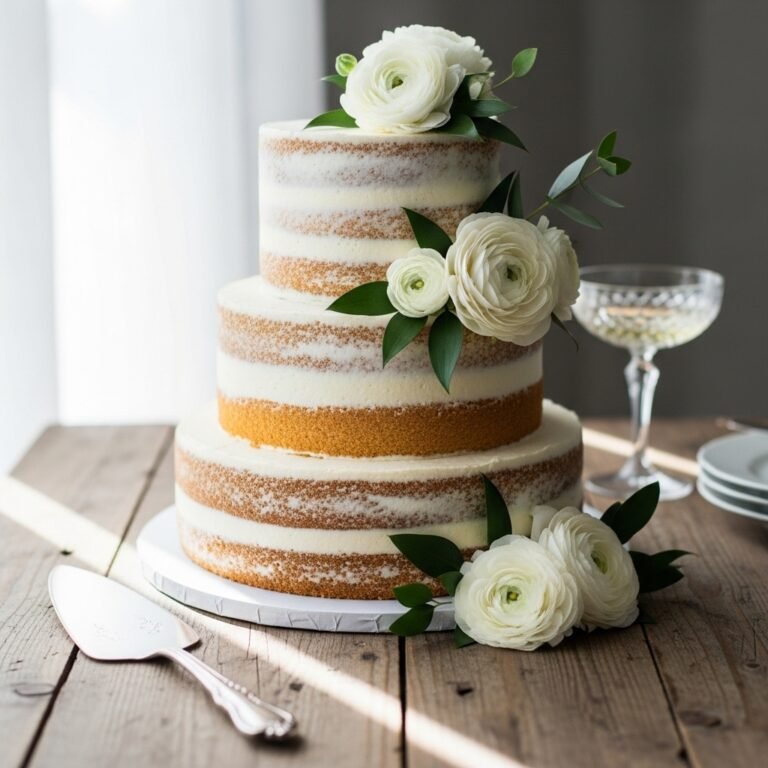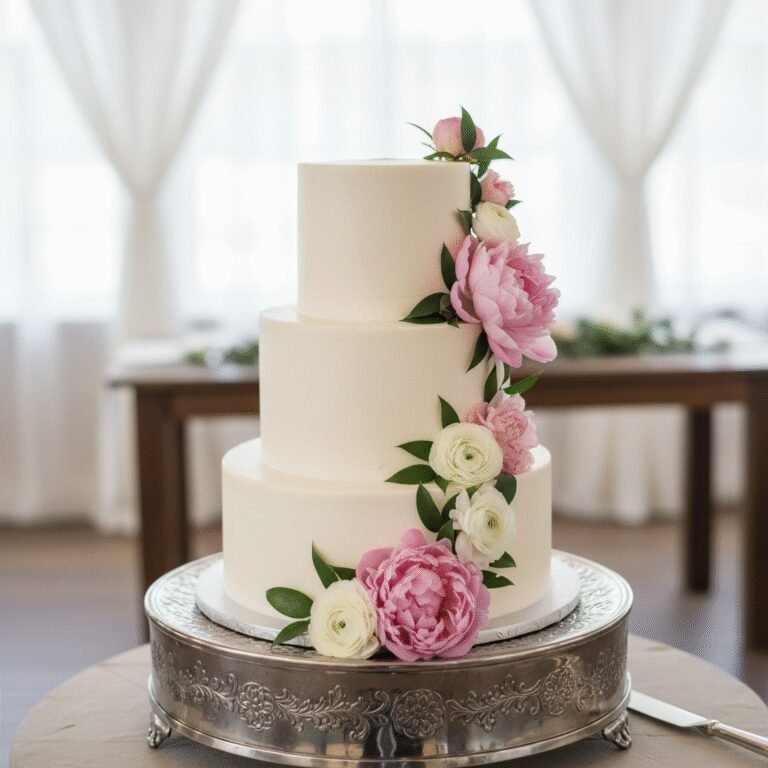
The Ultimate Elegant Almond Wedding Cake With Gold Leaf Decoration
Elegant Almond Wedding Cake With Gold Leaf Decoration Recipe
This show-stopping almond wedding cake combines the nutty sophistication of almond paste with the silky luxury of Swiss meringue buttercream. Adorned with genuine 24k gold leaf, it is the epitome of edible elegance for your special day.
3 hours
1 hour 30 minutes
4 hours 30 minutes
30-40 servings (2-tier cake)
Dessert
Baking
American / European
Vegetarian
There is something undeniably magical about a wedding cake. It stands as the centerpiece of the reception, a towering symbol of celebration, sweetness, and the new life beginning for the happy couple. While trends in wedding desserts come and go—from rustic naked cakes to elaborate fondant sculptures—the classic elegance of a smooth buttercream finish accented with gold never fades. This Elegant Almond Wedding Cake with Gold Leaf Decoration is designed for the baker who wants to create a professional-quality masterpiece at home.
The flavor profile is deeply rooted in the use of high-quality almond paste, which provides a moist, dense, and velvety crumb that puts standard vanilla cakes to shame. Unlike light and airy sponges that can dry out or collapse under the weight of multiple tiers, this almond cake possesses the structural integrity required for stacking while remaining tender to the bite. We pair it with a silky Swiss Meringue Buttercream, less sweet than its American counterpart, allowing the subtle nuttiness of the almond to shine through.
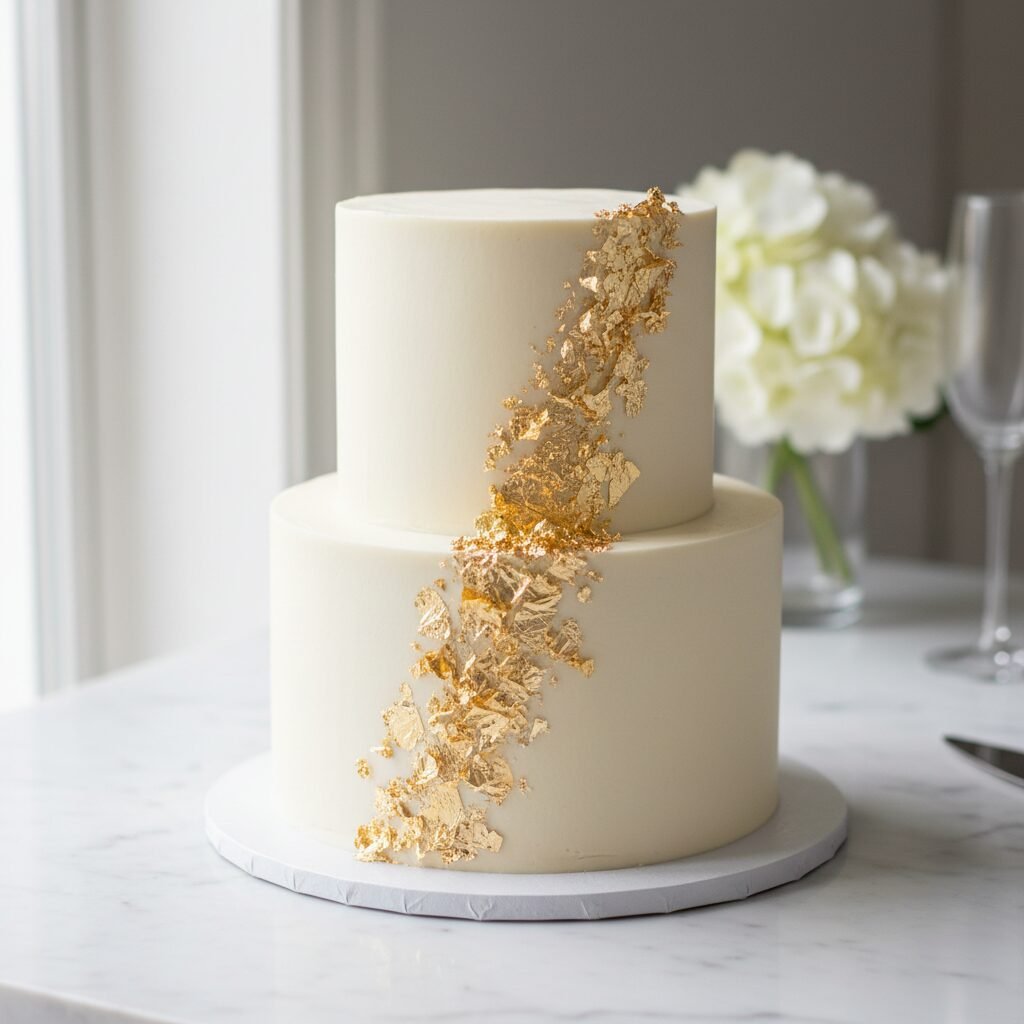
The aesthetic is modern minimalism meets royal luxury. The application of edible gold leaf transforms a simple white canvas into a work of art, catching the light and adding a texture that feels organic yet opulent. Whether you are a bride baking her own cake, a dedicated friend gifting a labor of love, or a budding pastry chef looking to expand your repertoire, this guide will walk you through every step of creating a confection that tastes as expensive as it looks.
History & Origins
The tradition of the wedding cake is steeped in centuries of history and symbolism, evolving from humble beginnings to the architectural marvels we see today. In Ancient Rome, marriages were finalized by breaking a barley cake over the bride’s head to symbolize fertility and good fortune. By the Middle Ages in England, guests would stack small spiced buns as high as possible, and if the bride and groom could kiss over the tower without knocking it down, they were guaranteed a prosperous life. This eventually evolved into the French Croquembouche and, later, the tiered cakes we recognize today.
The specific use of almonds in celebratory baking has its own rich lineage. Almonds have long been associated with well wishes; in Greek and Italian traditions, sugar-coated almonds (Jordan almonds) are distributed to guests to represent the bittersweet nature of marriage—the sugar coating creates a wish that the couple’s life will be more sweet than bitter. The almond flavor profile became particularly popular in high-end European patisserie through the use of marzipan and frangipane.
The modern tiered wedding cake as we know it was solidified in the Victorian era. Queen Victoria’s wedding to Prince Albert featured a cake with pure white icing, which was a status symbol at the time due to the high cost of refined white sugar. This ‘royal icing’ set the standard for wedding cakes for over a century. The addition of gold leaf is a more contemporary twist, reflecting a shift towards metallic accents in interior design and fashion in the 21st century. Edible gold has historically been a sign of extreme wealth and divinity, used in feasts by nobility in Medieval Europe and by Pharoahs in Ancient Egypt. Today, combining the Victorian tiered structure with the ancient luxury of gold and the traditional symbolism of almonds creates a dessert that bridges eras.
Why This Recipe Works
This recipe succeeds where many others fail because it prioritizes both structural stability and moisture content—two qualities that are often at odds in cake baking. Most home bakers are familiar with the ‘creaming method’ (beating butter and sugar first), but for this high-ratio cake, we utilize the ‘reverse creaming method’ or the ‘two-stage method.’ By mixing the dry ingredients with the butter before adding the liquid, we coat the flour proteins in fat. This inhibits gluten formation, resulting in a crumb that is exceptionally tender and velvety, yet dense enough to support the weight of stacking and decorating without bulging.
Furthermore, the inclusion of almond paste rather than just almond extract is a game-changer. Extracts can bake out or taste artificial, but almond paste adds actual nut solids and sugar, contributing to the cake’s moisture retention. This means the cake can be baked a day or two in advance without drying out—a crucial logistical advantage for wedding preparations.
Finally, the choice of Swiss Meringue Buttercream (SMBC) over American Buttercream is strategic. SMBC is much more stable in varying temperatures and forms a smooth, non-crusting outer shell that is perfect for adhering gold leaf. Its buttery texture glides over the cake layers, allowing for those sharp, professional edges that define a modern elegant aesthetic. The gold leaf adheres effortlessly to the slight tackiness of the buttercream, creating a finish that looks professionally gilded.
Why You’ll Love This Recipe
- ✓Uses the reverse creaming method for a velvety, sturdy crumb.
- ✓Real almond paste provides deep flavor and prolonged moisture.
- ✓Swiss Meringue Buttercream offers superior stability and smoothness.
- ✓Edible gold leaf creates a high-end, professional aesthetic.
- ✓Structural integrity allows for safe stacking of tiers.
- ✓Can be made in stages to reduce stress on the big day.
Equipment You’ll Need
- ✓Stand mixer with paddle and whisk attachments
- ✓Three 8-inch round cake pans
- ✓Three 6-inch round cake pans
- ✓Digital kitchen scale
- ✓Cake turntable
- ✓Offset spatula
- ✓Bench scraper
- ✓Cake dowels or bubble tea straws
- ✓Cardboard cake rounds (6-inch and 8-inch)
- ✓Food-safe tweezers or fan brush for gold leaf
Ingredients
- ✓For the Cake:
- ✓750g Cake flour, sifted
- ✓600g Granulated sugar
- ✓400g Unsalted butter, room temperature
- ✓300g Almond paste, broken into small pieces
- ✓30g Baking powder
- ✓5g Salt
- ✓480ml Whole milk, room temperature
- ✓12 Large egg whites, room temperature
- ✓10ml Pure vanilla extract
- ✓10ml Almond extract
- ✓For the Swiss Meringue Buttercream:
- ✓400g Egg whites (pasteurized)
- ✓600g Granulated sugar
- ✓900g Unsalted butter, cubed and cool
- ✓15ml Vanilla bean paste
- ✓Pinch of salt
- ✓Decoration:
- ✓1 Booklet of 24k edible gold leaf (transfer sheets recommended)
Instructions
- 1. PREPARE THE OVEN AND PANS: Preheat your oven to 335°F (168°C). Grease your 8-inch and 6-inch cake pans generously, line the bottoms with parchment paper, and grease the paper. Dust with flour and tap out the excess.
- 2. MIX DRY INGREDIENTS AND BUTTER (Reverse Creaming): In the bowl of a stand mixer fitted with the paddle attachment, combine the sifted cake flour, sugar, baking powder, and salt. Mix on low speed for 30 seconds to combine. Add the room temperature butter and the almond paste pieces. Mix on low speed until the mixture resembles damp sand and no large chunks of almond paste remain.
- 3. COMBINE WETS: In a separate pitcher, whisk together the milk, egg whites, vanilla extract, and almond extract.
- 4. CREATE THE BATTER: With the mixer on low, slowly pour in half of the milk mixture. Increase speed to medium and beat for 2 minutes to develop structure. Scrape down the bowl. Reduce speed to low and add the remaining milk mixture in two batches, mixing just until incorporated. Do not overmix.
- 5. BAKE: Distribute the batter among the pans (fill about 2/3 full). Bake for 30-45 minutes, or until a toothpick inserted into the center comes out clean. The 6-inch cakes will bake faster than the 8-inch cakes. Check early.
- 6. COOL: Let cakes cool in pans for 15 minutes, then turn out onto wire racks to cool completely. Wrap in plastic wrap and chill in the fridge for at least 1 hour to firm up for stacking.
- 7. MAKE THE BUTTERCREAM: Combine egg whites and sugar in a heatproof bowl over a pot of simmering water (double boiler). Whisk constantly until sugar is dissolved and mixture reaches 160°F (71°C). Transfer to stand mixer with whisk attachment. Whip on high until stiff glossy peaks form and the bowl feels cool to the touch (about 10-15 minutes).
- 8. ADD BUTTER: Switch to paddle attachment. With mixer on low, add cubed butter one piece at a time. Once all butter is added, increase speed to medium-high and whip until silky and smooth. Add vanilla bean paste and salt. Mix on low for 2 minutes to remove air bubbles.
- 9. ASSEMBLY: Level the tops of your chilled cakes. Place a dab of buttercream on an 8-inch cake board. Place the first 8-inch layer down. Pipe a dam of buttercream and fill. Repeat for all 8-inch layers. Crumb coat the tier and chill. Repeat the process for the 6-inch tier on a 6-inch board.
- 10. FINAL COAT: Apply a thick final layer of buttercream to both tiers. Use a bench scraper to smooth the sides and an offset spatula to sharpen the top edges. Chill until firm (at least 30 minutes).
- 11. STACKING: Insert dowels into the center of the bottom tier, cut flush with the top of the cake. Carefully place the 6-inch tier on top of the 8-inch tier.
- 12. GOLD LEAF APPLICATION: Ensure your hands are completely dry. Using tweezers or a dry fan brush, gently lift a sheet of gold leaf. Press it gently onto the side of the cake. Rub the backing paper to adhere, then peel away the paper. Use the brush to smooth it down or distress it for an organic look. Repeat in a cascading pattern.
- 13. SERVE: Allow the cake to come to room temperature before serving for the best texture.
Expert Cooking Tips
- ✓Room Temperature Ingredients: Ensure butter, milk, and eggs are at room temperature to prevent the batter from curdling.
- ✓Don’t Overmix: Once the liquid is added, mix only until combined to keep the cake tender.
- ✓Weigh Your Batter: For even layers, weigh the batter in each pan using a digital scale.
- ✓Chill Before Stacking: Cold cake is much easier to handle and trim than room temperature cake.
- ✓Bubbles in Buttercream: If your frosting has air bubbles, mix it on the lowest speed with the paddle attachment for 5 minutes to smooth it out.
- ✓Gold Leaf Handling: Avoid touching gold leaf with your fingers; it will stick to the moisture on your skin instantly.
- ✓Doweling is Key: Never stack a tiered cake without internal supports (dowels) in the bottom tier, or it will collapse.
Substitutions and Variations
If you cannot find almond paste, do not substitute it with marzipan, as marzipan has a much higher sugar content and will alter the structure of the cake. Instead, you can increase the almond extract slightly and use finely ground almond flour in place of 10% of the cake flour, though the texture will differ slightly. For a gluten-free version, replace the cake flour with a high-quality 1:1 gluten-free baking flour blend that contains xanthan gum. If you prefer a different frosting, an Italian Meringue Buttercream works equally well, or an American Buttercream can be used, though it will be much sweeter and crust over. For the gold leaf, you can use edible gold luster dust mixed with a little vodka to paint on gold accents if leaf is too difficult to source or handle.
Common Mistakes to Avoid
The most common mistake with this recipe is failing to properly incorporate the almond paste. If you don’t break it down enough with the butter and sugar, you will end up with hard lumps of paste in the baked cake which can create holes in the crumb. Another frequent error is rushing the buttercream. If you add the butter while the meringue is still warm, the mixture will turn into a soupy mess. If this happens, pop the bowl in the fridge for 15 minutes and whip again. Lastly, handling gold leaf in a humid environment or with damp hands is a recipe for disaster. The gold will shrivel and stick to everything but the cake. Work in a cool, dry room if possible.
Serving Suggestions
This cake is best served at room temperature. If it has been refrigerated, allow it to sit out for at least 3-4 hours before cutting. Cold butter cake feels dry and hard, but it softens into a melt-in-your-mouth texture as it warms up. Serve slices with a side of raspberry coulis or fresh berries to cut through the richness of the buttercream. A glass of dry champagne or a floral tea like Earl Grey pairs beautifully with the almond notes. For cutting, use a sharp, warm knife and clean it between each slice for neat, professional-looking portions.
Storage and Reheating Tips
Leftover cake can be stored in an airtight container at room temperature for up to 2 days, provided the filling is not perishable (like custard or fresh fruit). For longer storage, keep it in the refrigerator for up to 5 days, but ensure it is well-wrapped or in a sealed container to prevent it from absorbing fridge odors. This cake freezes exceptionally well. Wrap individual slices or whole tiers tightly in two layers of plastic wrap followed by a layer of aluminum foil. It can be frozen for up to 3 months. Thaw in the refrigerator overnight and bring to room temperature before eating.
Nutrition Facts (Estimated)
| Serving Size | 1 slice |
| Calories | 650 |
| Fat | 35g |
| Saturated Fat | 18g |
| Unsaturated Fat | 15g |
| Trans Fat | 0.5g |
| Cholesterol | 95mg |
| Sodium | 210mg |
| Carbohydrates | 70g |
| Fiber | 2g |
| Sugar | 45g |
| Protein | 6g |
Frequently Asked Questions
Can I make the cake layers ahead of time?
Yes, absolutely. The almond layers actually develop better flavor after resting. You can bake them, cool them, wrap them tightly in plastic wrap, and freeze them for up to a month. Thaw them in the fridge the day before you plan to decorate.
Is edible gold leaf safe to eat?
Yes, as long as you purchase ‘edible’ gold leaf, which is biologically inert and passes through the body without being absorbed. Ensure it is 23k or 24k pure gold.
Why did my buttercream curdle when I added the butter?
This usually happens if the butter was too cold or the meringue was too warm. Keep whipping! It almost always comes back together. If it looks soupy, chill it briefly. If it looks curdled, heat the side of the bowl with a hair dryer while whipping.
Do I really need dowels for a 2-tier cake?
Yes. Even a small top tier is heavy. Without dowels in the bottom tier to support the weight, the bottom cake will eventually bulge or crush, ruining the aesthetic.
Can I use all-purpose flour instead of cake flour?
You can, but the cake will be denser and slightly tougher. If you must, remove 2 tablespoons of AP flour per cup and replace it with cornstarch to mimic the protein content of cake flour.
How do I transport this cake?
Transport the cake in a sturdy box on a flat surface (like the floor of the car or the trunk), not on a slanted seat. Ensure the car is cool (air conditioning on high) to prevent the buttercream from melting.
How much gold leaf do I need?
For a cascading effect on a 2-tier cake, a standard booklet of 25 sheets (8x8cm) is usually sufficient. If you want to fully cover a tier, you will need significantly more.
What size pans should I use for 50 guests?
For 50 guests, you would likely need a 3-tier cake (10-inch, 8-inch, 6-inch) or a larger 2-tier (10-inch and 8-inch). This recipe yields enough for a standard 8-inch and 6-inch stack.
Conclusion
Creating your own wedding cake is a bold and loving gesture that adds a deeply personal touch to the celebration. This Elegant Almond Wedding Cake with Gold Leaf Decoration is more than just a dessert; it is a memory in the making. The process requires patience and precision, but the result—a stunning, shimmering tower of moist almond cake—is worth every minute of effort. Whether for a grand wedding, an intimate engagement party, or a milestone anniversary, this cake delivers on both style and substance. So turn on your favorite playlist, preheat that oven, and get ready to bake something truly spectacular.